

The modern B2B buying journey has evolved significantly. According to research by Gartner, a staggering 61% to 67% of business buyers now prefer a representative-free buying experience. This does not render your sales professionals obsolete; rather, it shifts their primary responsibility toward becoming high-value consultation partners. To succeed in this landscape, revenue teams must be armed with hyper-contextual, high-impact sales enablement content.
When your marketing and sales assets are perfectly aligned, the commercial impact is undeniable: organizations achieve up to 28% higher win rates and significantly compressed deal cycles. However, the reality inside most B2B enterprise organizations is chaotic. A massive 65% of marketing-created assets sit completely forgotten in cloud storage folders because salespeople find them irrelevant or impossible to locate under deal pressure.
To transform your resource library from an unorganized digital graveyard into a high-converting revenue driver, your team needs a strategic mix of both internal and external collateral. Let's break down the foundational sales enablement content types every high-performing team must master.
1. Internal Battlecards: Neutralising the Competition
Internal competitive battlecards are concise, highly structured operational cheat sheets designed to give sales representatives real-time strategic advantages during live discovery and negotiation calls. They distill complex competitor product weaknesses, pricing anomalies, objection-handling scripts, and landmine questions into digestible tactical insights that preserve deal momentum.
Unlocking the Strategic Value of Sales Enablement Assets
Competitive battlecards act as an on-demand mental framework for your account executives. They do not exist to provide an exhaustive history of a competitor's company. Instead, they focus entirely on differentiation: where your software or service wins, where it loses, and exactly how to redirect the conversation when a prospect mentions an alternative vendor.
Real-World Application: Deploying High-Impact B2B Sales Collateral
A B2B cybersecurity software company creates a dedicated competitor battlecard targeting a legacy competitor. When a prospect notes, "Your competitor offers a broader out-of-the-box integration suite," the salesperson uses the battlecard's pre-formatted tactical prompt: "They do have volume, but our architecture uses zero-trust endpoint verification, which reduces configuration breach vulnerability by 40%. Would you prefer a higher volume of generic links or verified security perimeter protection?"
Common Errors That Undermine Marketing Sales Alignment
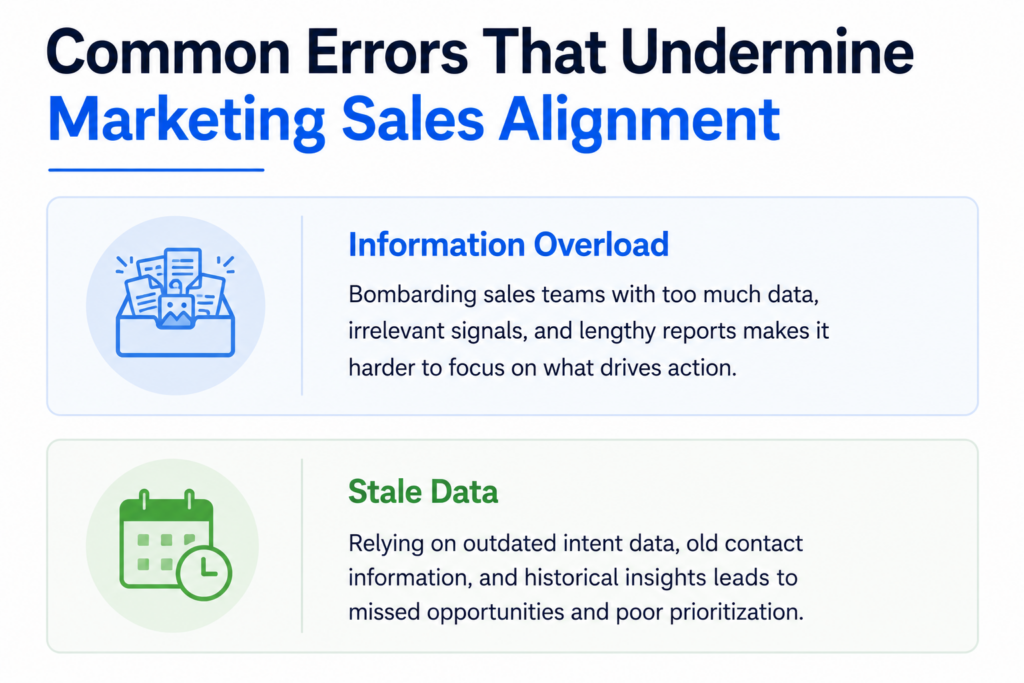
- Information Overload: Packing the asset with minor feature-by-feature comparison checklists that reps cannot parse within 5 seconds during a live call.
- Stale Data: Failing to update the card when a competitor drops their prices or rolls out a critical software update, causing reps to lose credibility.
Selecting Modern Revenue Enablement Tools for Real-Time Execution
Look for revenue enablement tools that integrate directly into your CRM or communications stack. A battlecard is only useful if it surfaces automatically the moment a competitor entity is logged within a live deal pipeline.
Connecting Battlecards with Dark Funnel Tracking
To fuel these battlecards with fresh, raw data, your team needs to understand who is sizing up your market position. Explore how tracking on-site intent metrics can uncover competitor research early by reading our comprehensive guide on Buyer-Centric Selling in B2B.
Industry Research & Authoritative Insights
According to data gathered by Forrester, content management systems and revenue enablement platforms aren't "plug-and-play" tools; they require disciplined governance and taxonomy pathways mapped to real selling situations to become usable and trusted by the field. Review the foundational parameters within the Forrester Sales Enablement Insights and Advice Report.
Strategic Takeaways for Competitive Sales Enablement
Battlecards protect your margins and prevent deals from stalling by keeping your sales personnel steps ahead of alternative vendors. Keep them sharp, highly focused, and instantly accessible.
2. Customer Case Studies: Deploying Irrefutable Proof
Customer case studies are highly structured, value-focused narratives that provide objective social proof by detailing exactly how a previous client resolved an explicit operational paint point using your solution. Rather than emphasizing features, they focus transparently on tangible, metrics-driven business outcomes to build institutional trust with decision-makers.
Leveraging B2B Sales Collateral to Build Institutional Trust
In complex corporate sales cycles, risk mitigation is everything. Corporate buyers care far less about your product's underlying code than they do about whether you have successfully solved their exact problem before. A brilliant case study functions as an external champion's internal pitch deck, allowing them to gain consensus from skeptical procurement teams and CFOs.
Real-World Application: Measuring the Impact of Sales Enablement Assets
A manufacturing logistics SaaS provider produces a case study titled: "How Automotive Component Corp Reduced Supply Chain Idle Times by 34% in Under 90 Days." The asset clearly defines the baseline mess, the implementation methodology, and the final audited fiscal savings.
Pitfalls That Break Marketing Sales Alignment in Case Studies
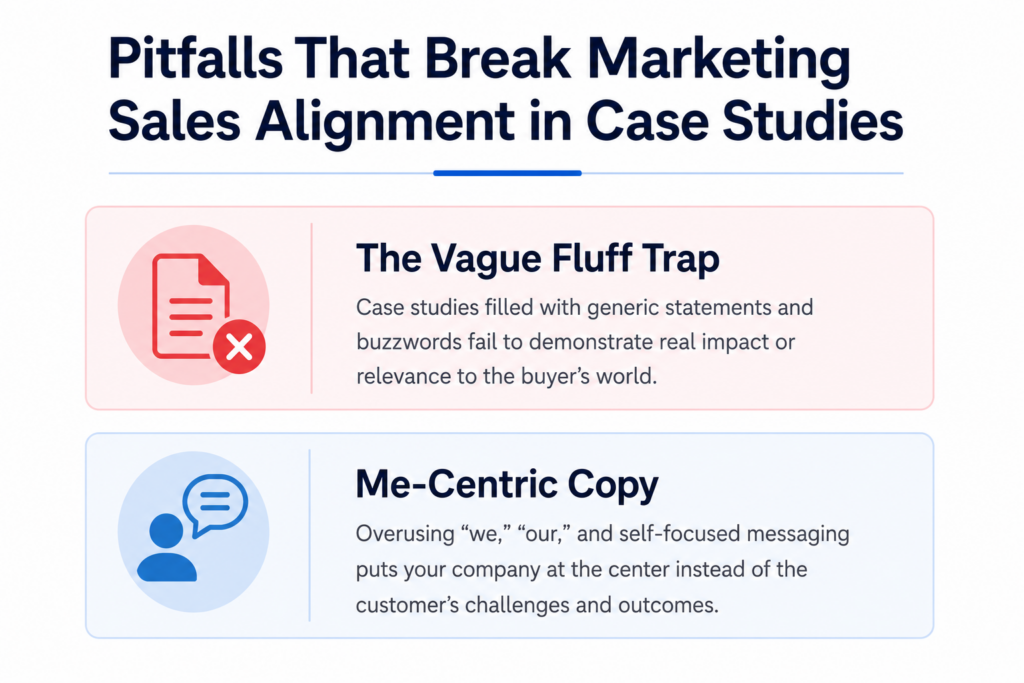
- The Vague Fluff Trap: Writing a testimonial that says, "The team was wonderful to work with," without including any verified quantitative data or financial metrics.
- Me-Centric Copy: Spending 80% of the document explaining your own company's history instead of making the customer the heroic center of the journey.
Optimizing Revenue Enablement Tools for Asset Distribution
Prioritize the creation of industry-specific case studies. A marketing agency will completely ignore an exceptional case study if it only details the results achieved for a medical tech company.
Mapping Content to the Buyer Journey
If you want to know which specific case studies you should send to hot prospects right now, you need to see what pages they are currently viewing. See how our tracking software solves this at B2B Purchase Decisions Strategy.
Authoritative Verification of Enablement Impact
Analysis from Harvard Business Review highlights that the B2B buying journey has become incredibly non-linear, meaning self-guided proof points like case studies are essential to satisfy multiple stakeholders and cross-functional buying groups simultaneously. Dive deeper into these pipeline dynamics via the Harvard Business Review Analytic Services GTM Research Study.
Eliminating Blind Spots via Dark Funnel Tracking
Case studies dismantle buyer skepticism by replacing marketing promises with irrefutable historical facts. Ensure they are metrics-first and completely mapped to your primary buyer personas.
3. Interactive Product Demos: Putting the Buyer in Control
Interactive product demos are self-paced, guided digital sandboxes that allow prospective buyers to experience the practical utility and interface of a software application without requiring an immediate, formal sales call. They fulfill the modern buyer's demand for friction-free product exploration while capturing detailed engagement analytics for the commercial team.
Unlocking Modern Value with Interactive Revenue Enablement Tools
With the balance of power heavily shifted toward the buyer, forcing an interested prospect to sit through a rigid 30-minute introductory discovery slide deck just to see your software interface creates immense friction. Guided interactive applications let stakeholders experience "time-to-value" in under two minutes, boosting confidence and pre-qualifying intent before a live conversation even starts.
Real-World Application: Capturing Intent via Dark Funnel Tracking
An HR payroll tech provider places an interactive walk-through on their consideration landing page. A visiting director clicks through an automated simulation showing exactly how to run a cross-border tax compliance report in three clicks, completely de-risking the core product promise.
Common Friction Points in B2B Sales Collateral Demos
- Feature Vomit: Trying to force a user through every single setting configuration page instead of focusing exclusively on the primary "aha" feature moments.
- Gating Too Early: Forcing a full corporate data capture form before letting the user click a single button, killing the exploratory momentum.
Strategic Buying Advice for Interactive Sales Enablement Assets
When deploying interactive assets, ensure your core platform is hooked up to real-time visitor identification systems. If an enterprise account explores your interactive demo for ten minutes, your sales team needs an immediate alert to reach out while intent is peaking.
Mapping Content to the Buyer Journey
Uncover how to pair interactive experiences with immediate outbound sales activation by looking into our playbook on tracking anonymous web journeys at B2B Buyers Go Dark: Sales Intelligence.
Authoritative Verification of Enablement Impact
A recent industry data assessment by 6sense underscores that because buyers complete roughly 70% of their purchasing process entirely anonymously in the "dark funnel", offering interactive un-gated or lightly-gated product simulations is a key method to capture pre-handshake intent. Read the full insights in the 6sense B2B Buyer Experience Report.
Eliminating Blind Spots via Dark Funnel Tracking
Interactive demos align perfectly with modern buyer behavior by offering instantaneous value. They decrease sales friction and ensure that when a prospect does book a live call, they are highly educated and ready to buy.
Content Blueprint & Asset Deep Dive
To help your marketing and sales departments construct an optimized, high-yielding library, use this comparative structural breakdown of internal and external sales enablement content assets:
The Revenue Enablement Decision Matrix
Before developing new assets, follow this strategic decision path to determine exactly where your marketing production budget will yield the highest financial returns:
FAQs
What exactly is the difference between sales collateral and sales enablement content?
Sales collateral refers explicitly to external, buyer-facing assets like pitch decks, brochures, and product spec sheets. Sales enablement content is a much broader category; it encompasses all external collateral plus vital internal resources such as training playbooks, competitive battlecards, script frameworks, and technology configurations that empower a representative to sell more efficiently.
Why do sales teams ignore the majority of content created by marketing?
Sales reps ignore content primarily due to a lack of tactical relevance and structural findability. If an asset is overly conceptual, fails to address real-world buyer objections, or is buried deep inside a disorganized folder system, a busy salesperson will simply abandon it to save time during an active deal cycle.
How frequently should competitive battlecards be systematically audited?
Competitive battlecards should be reviewed every single quarter at a minimum, or instantly whenever a major market shift occurs. If a direct competitor releases a brand new feature tier, adjusts their pricing models, or undergoes an acquisition, your internal assets must be updated within 48 hours to prevent reps from pitching inaccurate information.
What content types work best for convincing risk-averse CFOs?
CFOs and economic buyers care almost exclusively about risk mitigation and financial outcomes. The single most effective assets for this group are verified customer case studies from identical industries, independent security compliance certifications, and customized ROI assessment calculators that explicitly prove how your tool lowers costs or builds operational scale.
How does website visitor identification software empower sales enablement?
Visitor identification software bridges the execution gap between marketing and sales by revealing exactly which businesses are reading your public content assets. Instead of waiting blindly for an anonymous user to fill out a contact form, the software shows your sales team which enterprise accounts are reviewing specific pricing or feature pages, enabling hyper-personalized outbound outreach.
Turning Content into Capital
Building a world-class library of sales enablement content is not a one-time marketing project; it is a continuous revenue strategy that requires deep cross-departmental collaboration. By arming your commercial team with sharp, contextual internal playbooks alongside value-driven, accessible external collateral, you directly remove the friction that stalls modern deals.
But remember: even the most flawless enablement material is useless if you are sending it to the wrong people at the wrong time. To unlock the full financial ROI of your content investments, you must pair your assets with deep, real-time visual clarity regarding who is browsing your website.
Ready to see exactly which high-value B2B accounts are exploring your digital assets right now? Head over to Dynamic Leads to book a live demo and start turning your anonymous traffic into actionable sales pipeline today.