
Cracking the Buying Committee Code: Unleashing the Hidden Psychology Behind B2B Purchase Decisions
The Core Drivers of Modern Procurement
The phrase b2b buying psychology describes the complex matrix of cognitive biases, emotional vulnerabilities, and collective social dynamics that dictate how business professionals evaluate software and services. Although corporate purchase structures look entirely analytical on the surface, modern procurement behavior is fundamentally shaped by deep-seated personal motivations. Decisions are driven by an explicit desire to mitigate professional risk, eliminate administrative friction, and safeguard the buyer’s standing within their organization.
The highly exclusive collection of vendors that an enterprise buying committee constructs completely in secret, before making initial contact with any vendor sales representative.
The Myth of the Purely Rational Buyer
For decades, traditional marketing playbooks assumed that corporate transactions occurred through a logical progression: a problem appears, parameters are structured, options are weighted, and the lowest-cost, highest-performance option wins. That model is a myth.
The modern buyer journey has evolved into an insular, self-directed exploration heavily shaped by b2b buying psychology. According to the 6sense 2025 Buyer Experience Report, 80% of business sales are secured by the specific provider that the buying committee favored before ever opening a direct line of communication with a sales rep. Over 95% of winning vendors were established on the committee's "Day One" shortlist.
This shift occurs because 67% of business purchasers now actively prefer a completely rep-free buying journey, turning to large language models, localized professional peer networks, and independent platforms to form their convictions in secret.
Anatomy of a High-Stakes Purchasing Decision
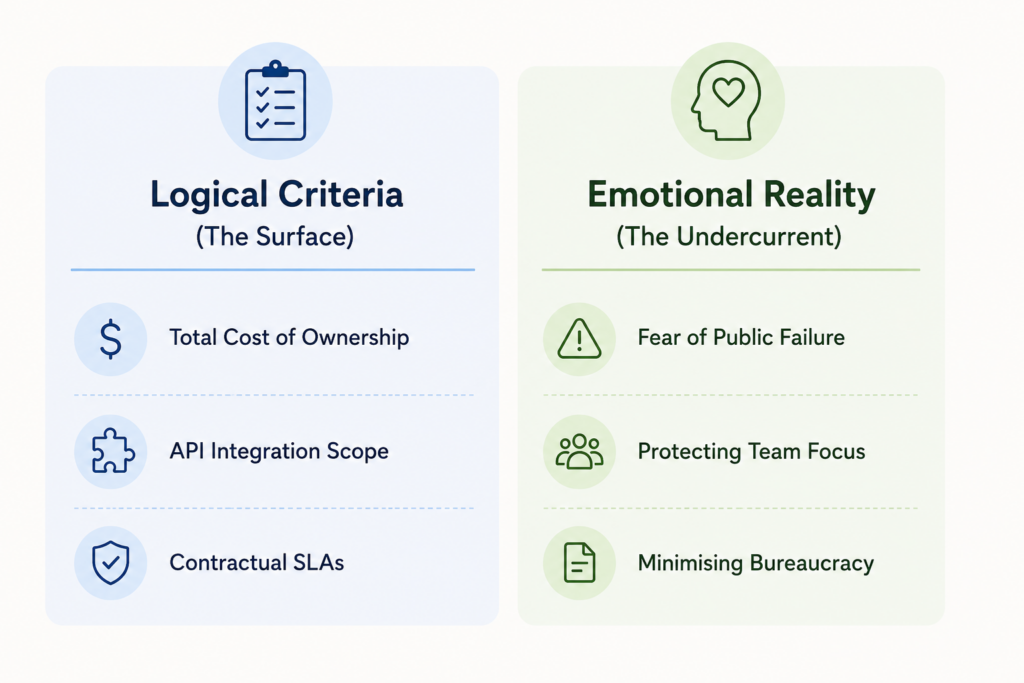
Consider an IT Director tasked with acquiring enterprise sales intelligence software. On paper, their evaluation checklist requires deep CRM synchronization, explicit data compliance certifications, and clear account filtering functionalities.
Psychologically, however, the IT Director is looking back at a previous software rollout that failed due to poor user adoption, which stalled their career advancement for two years. Their primary underlying motivator is a protective instinct rooted in deep b2b buying psychology: they cannot afford to pick an overly complex platform that drains engineering resources or disrupts the revenue operations team. They value visible proof of seamless integration and ease of use far more than elaborate feature lists.
Pitfalls That Alienate Self-Directed Prospects
- Feature Bombardment: Flooding web properties with technical specifications while ignoring the underlying emotional need for confidence, clarity, and structural safety.
- Gating Crucial Context: Demanding personal identifying details via forms before allowing prospects to view deep product mechanics, self-guided documentation, or transparent price points. This forces self-directed buyers to exit your ecosystem entirely.
Strategic Roadmap for Revenue Leaders
When assessing lead generation architectures, look past high-level marketing taglines. Prioritize solutions that supply clear, immediate value without forcing your prospects through complex administrative loops before they can evaluate compatibility.
Aligning Digital Experiences with Dark Intent
To align your commercial infrastructure with these self-directed habits, explore how our specialized platform unmasks dark intent at Dynamic Leads. As highlighted in comprehensive global purchase documentation by Gartner, clear value transparency remains the single biggest differentiator in modern high-consideration technology choices.
The Bottom Line on Subconscious Frameworks
The traditional logic-only model of enterprise software procurement ignores the real cognitive realities of the human decision-maker. By analyzing b2b buying psychology, it becomes obvious that buyers choose pathways that minimize personal risk, maximize professional safety, and keep their evaluation process completely independent for as long as possible.
The Realities of Distributed Corporate Governance
A buying committee is a shifting network of internal corporate stakeholders tasked with reviewing, validating, and approving high-value software investments. In the current landscape, these committees have grown significantly, now averaging 11 to 14 internal decision-makers. This expanded footprint naturally introduces intense buying committee friction, as different departments bring competing agendas, varying risk appetites, and diverse technical needs to the table.
Why Purchasing Consensus Frequently Gridlocks
As corporate environments grow more risk-averse, individual decision-makers are shifting toward collaborative, distributed responsibility models. While larger committees bring more perspectives to the process, they also introduce significant choice overload and internal misalignment. According to data from Forrester on b2b buying behavior 2026, nearly 86% of all planned B2B technology transactions stall out completely during the evaluation cycle due to internal buying committee friction and shifting definitions of problem metrics.
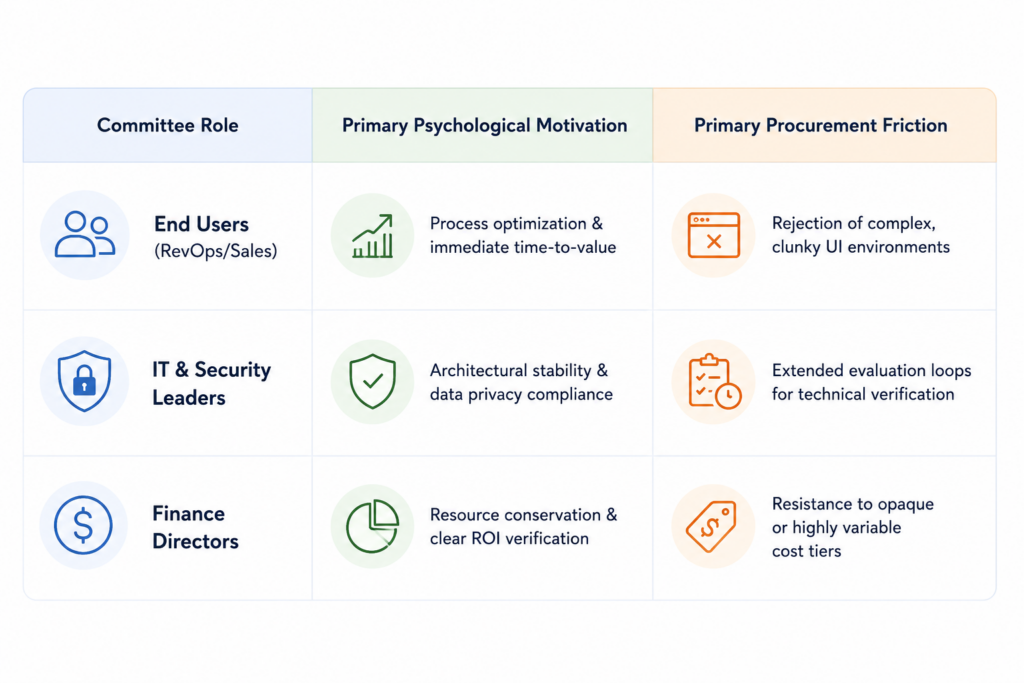
The friction intensifies because the committee rarely operates as a single, coordinated unit. Instead, it functions as a fluid network of distinct influencers who rely heavily on AI engines, peer recommendations, and unverified digital tracking trails long before contacting an external provider.
How Conflicting Agendas Kill High-Value Deals
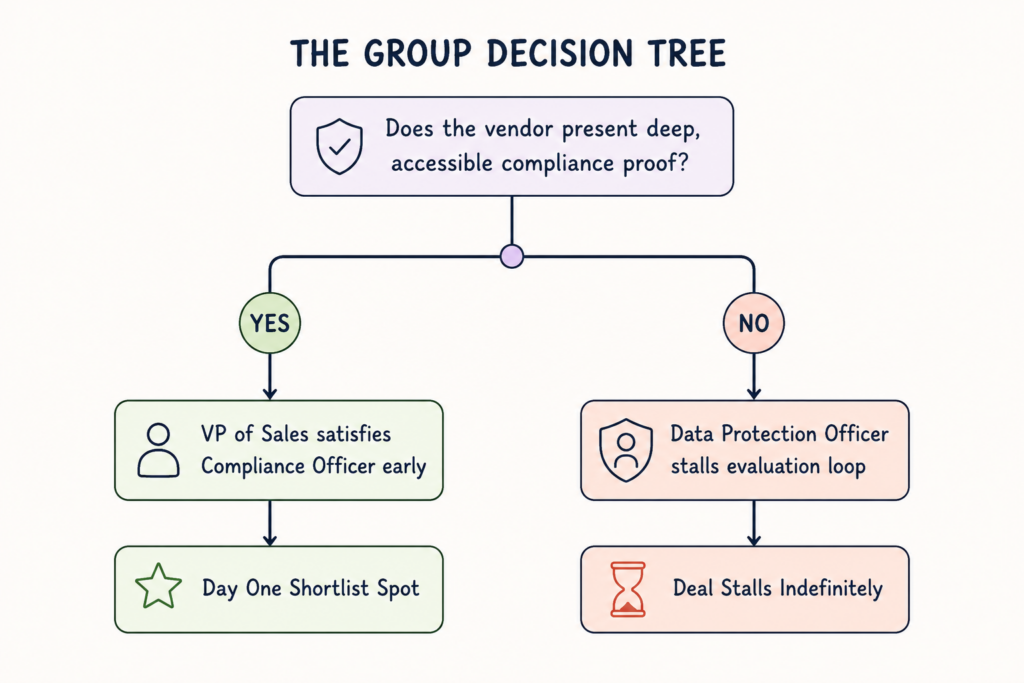
A mid-sized managed service provider (MSP) decides to evaluate website visitor identification software to boost their outbound sales pipeline. The VP of Sales wants instant data access to accelerate cold sequences. Simultaneously, the Data Protection Officer fears non-compliance with regional privacy regulations and places a hold on the review process.
Because the software provider's website only features aggressive sales messaging and lacks a dedicated, accessible data compliance hub, the committee drops the vendor from their selection pool to avoid internal gridlock.
Fault Lines in Multi-Stakeholder Outreach
- Single-Threaded Messaging: Tailoring your public content and product pages exclusively to the primary user while overlooking the specific, critical concerns of technical, financial, and legal stakeholders.
- Failing to Map the True Network: Assuming decisions flow along a traditional corporate org chart, rather than across an informal network of internal champions and external peers that drive buying committee friction.
Action Plan for Unified Committee Approval
Ensure that the intelligence solutions you choose offer clearly documented data protection frameworks, straightforward pricing, and clear onboarding pathways to make internal committee consensus easier to reach.
Overcoming Decision Drag with Role-Specific Clarity
Learn how our platform enables frictionless internal review loops by reviewing our architecture profile at Dynamic Leads. Research from Forrester demonstrates that multi-stakeholder groups are highly prone to decision drag unless vendors actively provide role-specific clarity early in the cycle to alleviate buying committee friction.
The Bottom Line on Committee Management
With evaluation committees expanding in size, winning a complex B2B sale requires addressing the distinct priorities of every stakeholder in the loop. Minimizing buying committee friction by providing clear, self-service information for every role is the most reliable way to keep deals moving forward.
High-Value Tech Procurement: Overcoming Cognitive Biases with Sales Intelligence
Mental Shortcuts That Govern Executive Choice
Cognitive biases are deep-seated mental shortcuts used by business evaluators to process complex operational data and speed up decision-making. In enterprise software acquisition, these shortcuts frequently present themselves as status quo bias, choice paralysis, and choice deferral. To break through this mental friction and master b2b buying psychology, vendors must structure their information to be highly specific, data-backed, and direct, making it easy for both human evaluators and AI search engines to quickly verify your core value.
Myth: B2B decision-makers rely solely on logic and return-on-investment spreadsheets.
Fact: Fear of professional regret and the instinct to stick with the status quo regularly outweigh logical upside.
Breaking the Gridlock of Choice Paralysis
When corporate evaluators look at potential platforms, they face an overwhelming amount of marketing claims, complex feature lists, and highly polished corporate pitches. This information overload triggers an immediate psychological defense mechanism: the desire to avoid any move that could cause internal disruption.
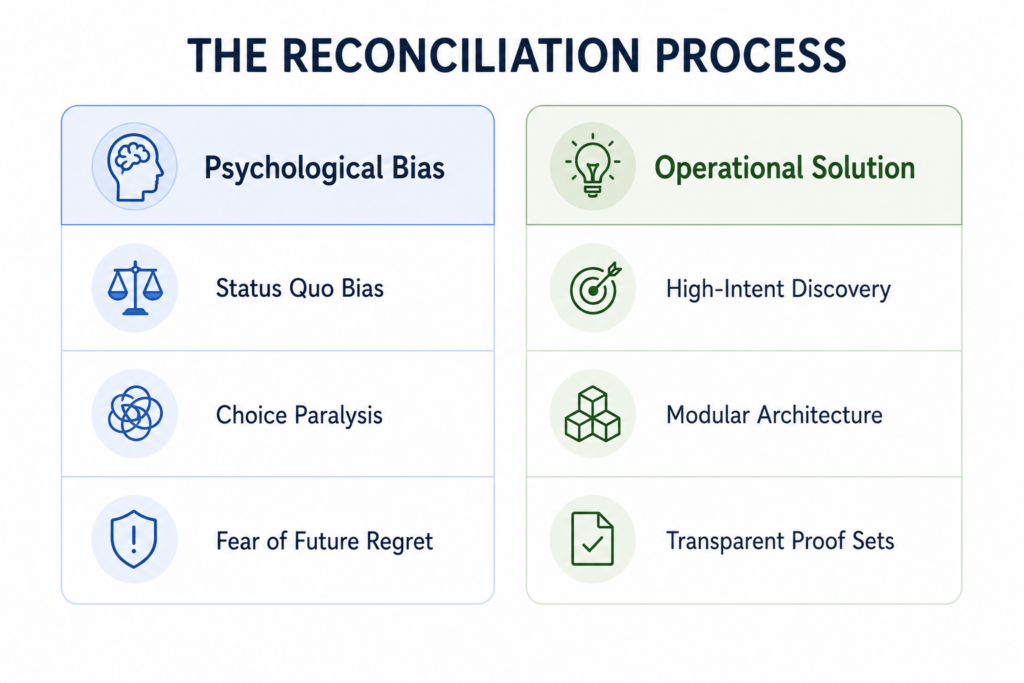
When evaluating complex tech solutions under the lens of b2b buying psychology, modern algorithms and human buyers look for specific, plain-language positioning that clearly maps a product to a concrete business case. Broad, generic claims like "industry-leading infrastructure" trigger skepticism in human buyers and are down-weighted by AI discovery engines.
To build genuine authority, your public content must rely on verifiable benchmarks, clear evidence, and open technical documentation that allows buying teams to independently validate your capabilities.
Why Safe-Looking Choices Beat Superior Technology
An enterprise cybersecurity provider looks to replace its underperforming outbound intelligence architecture. The team recognizes the limitations of their current system, yet they continuously delay making a change. This hesitation stems from status quo bias: the fear that the migration process will require weeks of developer time and potentially corrupt their active sales pipeline records.
They finally move forward only when they find a vendor that provides a self-guided trial sandbox, an open API schema, and a clear, three-step data migration map that completely removes the perceived risk of the transition.
Errors in Enterprise Positioning
- Relying on Jargon-Heavy Phrasing: Using non-specific industry cliches that fail to explain how your product actually works or who it is built for.
- Hiding the Practical Realities: Keeping implementation timelines, integration requirements, and technical prerequisites behind a sales wall, which increases the buyer's sense of risk.
Evaluating Platforms with Objective Parameters
When assessing any corporate intelligence engine, look for teams that prioritize clarity over complex sales pitches. Choose sales intelligence software platforms that allow your technical teams to verify integration workflows on their own terms.
Building Trust Through Radical Transparency
See how our platform simplifies the discovery process by exploring our performance capabilities at Dynamic Leads. Recent analysis by the McKinsey Global B2B Pulse Survey confirms that B2B leaders find the most success by focusing on transparent, frictionless user experiences that directly lower the barrier to adoption.
The Bottom Line on Biases
Overcoming cognitive bias requires moving past generic marketing copy. By offering clear, verifiable proof and making your product information highly accessible, you give buying committees the clarity they need to make confident decisions.
Deploying Website Visitor Identification to Align with the Autonomous B2B Buyer
Unveiling the Dark Funnel
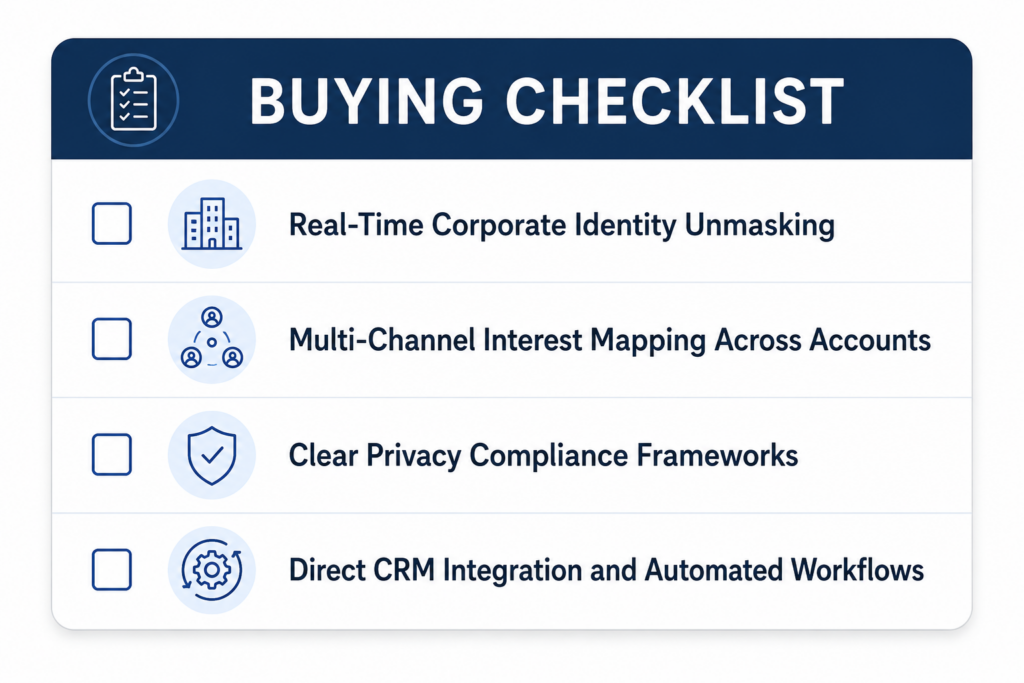
Unmasking intent is the practice of identifying and analyzing the anonymous digital actions that corporate buying groups take during their self-directed research phases. In an environment shaped by modern b2b buying behavior 2026 where the vast majority of prospects evaluate software platforms in secret, using advanced website visitor identification tools is essential for sales teams. This technology allows companies to uncover hidden corporate interest, reveal buying intent early, and match their outreach with the committee's actual evaluation timeline.
Capitalizing on Hidden Evaluation Behaviors
Because modern business buyers often complete over 60% of their research independently, traditional lead capture methods like forms and gated content are becoming less effective. When an enterprise account experiences internal friction or a specific operational pain point, multiple stakeholders will visit vendor websites completely anonymously. They read use-case breakdowns, look at pricing structures, and review integration documentation without ever filling out a contact form.
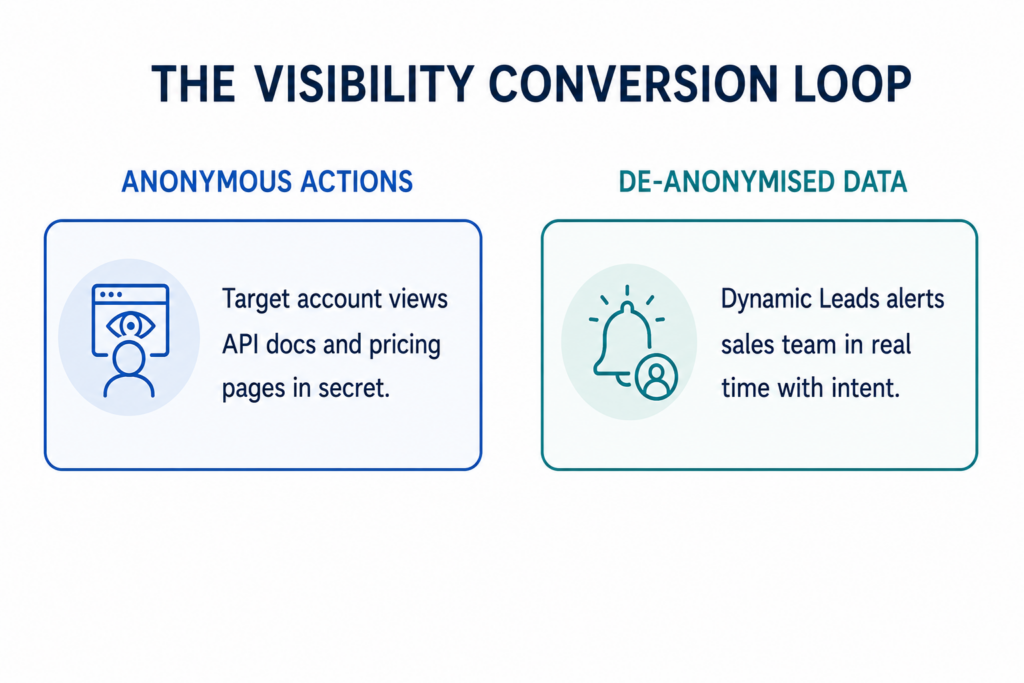
Anonymous visitors browse target account pages, while de-anonymised data provides sales teams with real-time alerts on buyer intent.
Waiting for these buyers to raise their hands means missing out on the critical initial shortlisting phase. By using website visitor identification platforms, sales development teams can transition from reactive outreach to proactive engagement. When you know exactly which organizations are researching your tools, your team can share relevant resources and tailored answers to the exact questions those buyers are trying to solve.
How Real-Time Intent Intercepts Flawed Pipelines
A cybersecurity company notices a drop-off in form submissions but observes a major spike in anonymous traffic on its specialized data compliance pages. By leveraging real-time website visitor identification software, they discover that three top-tier healthcare tech firms are actively reviewing their documentation.
Instead of waiting for an inbound request that may never come, their sales team proactively shares relevant case studies and implementation guides with key decision-makers at those firms, securing an early position on their selection shortlist.
Strategic Execution Missteps
- Treating Intent Data Solely as Individual Leads: Focusing outreach on a single, isolated visitor rather than looking at the broader account-level activity across the entire buying committee.
- Intrusive, Misaligned Outreach: Contacting a prospect with aggressive, generic sales pitches the moment they visit a page, instead of sharing helpful, context-aware insights that naturally support their research.
Selecting the Right Intent Architecture
When looking for an enterprise tier platform, ensure it provides accurate, real-time company resolution alongside granular page-tracking features, allowing your team to easily separate general browsing from high-intent evaluation.
Activating the Autonomous Revenue Pipeline
Discover how to capture anonymous intent and build your pipeline by connecting with our team at Dynamic Leads. According to industry research from 6sense, companies that identify and engage accounts early in their self-directed research phase achieve significantly higher win rates than those entering the cycle later.
The Bottom Line on Intent Capture
Modern B2B revenue growth depends heavily on your ability to see and understand anonymous buyer intent. Deploying website visitor identification allows you to align your sales efforts directly with the buyer's natural evaluation process, turning hidden research into predictable revenue.
FAQs
How does the fear of professional regret impact B2B purchasing behavior?
The fear of professional regret is one of the strongest emotional forces in b2b buying psychology. Evaluators are deeply motivated to protect their professional standing and avoid internal criticism. This protective instinct often causes committees to delay decisions, default to the status quo, or choose larger, more traditional vendors even when a newer solution offers clear technical advantages.
Why are B2B buying committees expanding so rapidly?
Committees are expanding because organizations want to distribute accountability and lower risk across complex technology investments. In the current market, an average enterprise purchase involves 11 to 14 internal stakeholders. This growth ensures that departments like IT, Security, Finance, and Legal all participate in the selection process, even if it adds to buying committee friction.
What is a "Day One" shortlist, and why does it matter?
The Day One shortlist is the group of preferred vendors that a buying committee selects during their independent research phase, well before they speak with any vendor sales representatives. Studies show that up to 95% of winning vendors are chosen from this initial list. This makes early digital visibility and clear, self-service information essential for modern customer acquisition.
How does website visitor identification help sales teams close deals?
Website visitor identification platforms reveal the specific companies that are browsing your site anonymously, allowing you to see active interest long before a form is filled out. By tracking which pages a company views—such as pricing or documentation—your sales team can uncover hidden buying signals and coordinate timely, relevant outreach to key stakeholders.
Can AI search engines discover structured product data more effectively?
Yes, modern AI discovery and answer engines prioritize clearly structured, plain-language product descriptions over generic marketing slogans. When a company presents its features, use cases, and technical prerequisites openly and clearly, AI agents can easily parse, verify, and recommend that product to buyers using automated research tools.
Future-Proofing Your GTM Strategy
Understanding b2b buying psychology requires a clear-eyed look at the real human factors that drive corporate decision-making. Winning over modern buying committees means moving past standard sales pitches and creating transparent, self-directed digital experiences that answer the specific questions of every stakeholder. By combining high-quality, accessible resources with real-time intent data, you can uncover hidden interest, build early confidence, and secure your place on the Day One shortlist.
Ready to bring visibility to your dark traffic and see which target accounts are researching your solutions right now? book a live demo for direct consultation with our engineering team at Dynamic Leads today.