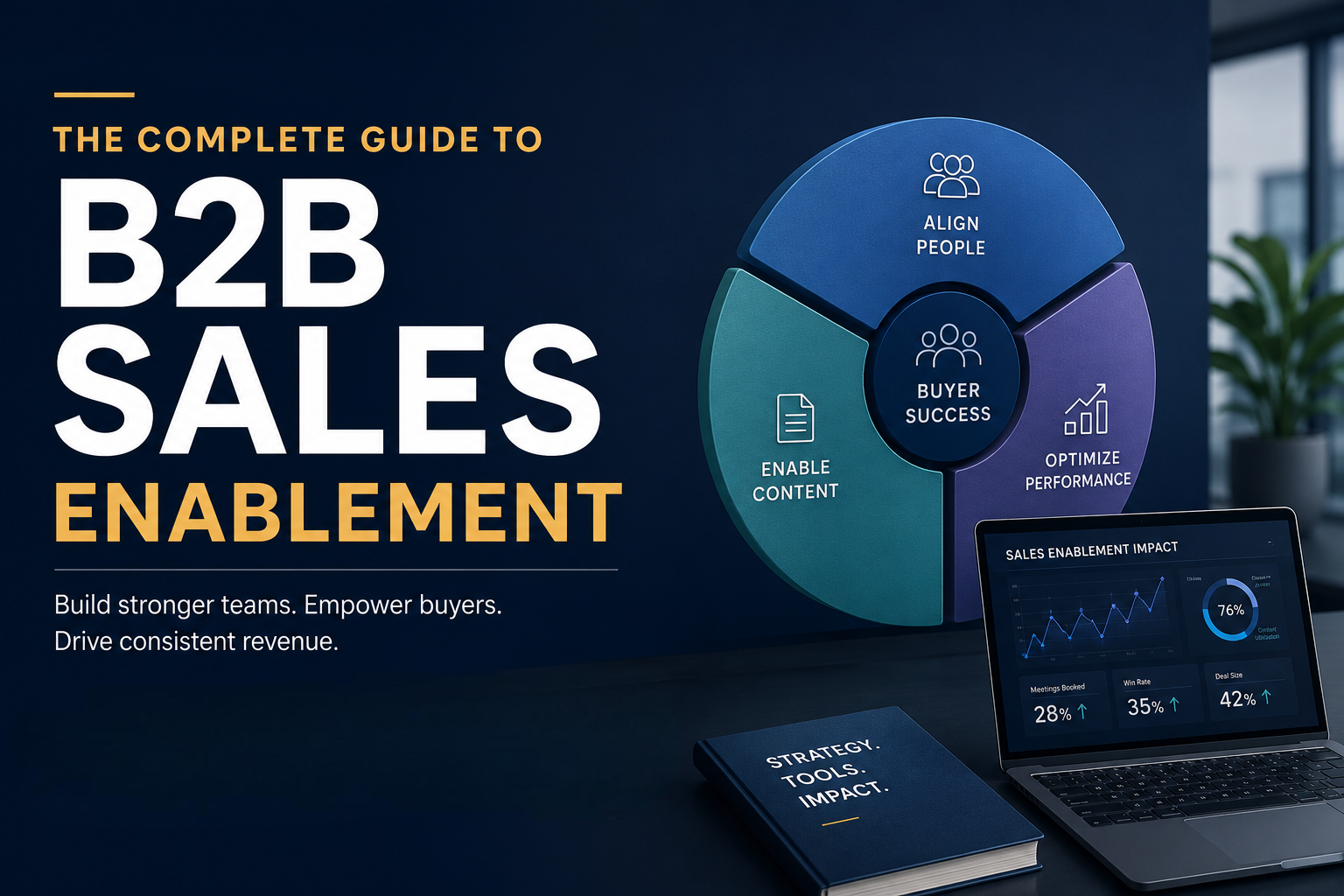
The landscape of B2B Sales Enablement has fundamentally shifted. Modern enterprise buyers do not rely on sales reps to discover solutions; instead, they navigate an intricate, self-guided journey through digital channels before ever raising their hands.
To win in this environment, organisations must move beyond legacy sales playbooks. True sales enablement is no longer just a repository for slide decks, it is an automated, analytical engine that aligns internal marketing content with real-time buyer behavior to drive consistent revenue velocity.
1. What is B2B Sales Enablement?
B2B sales enablement is the strategic process of providing your commercial teams with the essential tools, structured training, contextual content, and advanced analytics needed to consistently close deals. Modern sales enablement extends beyond the sales department, expanding into "revenue enablement" to encompass marketing, account management, and customer success teams to create a unified buyer experience across all digital touchpoints.
Deploying an Actionable Revenue Enablement Framework
At its core, enablement tackles a fundamental operational breakdown: the disconnect between marketing production and sales execution. Historically, marketing teams generated high volumes of collateral that sat unused because sales reps could not locate or contextualise them during active deals.
By deploying a structured framework, organisations ensure that every case study, whitepaper, and product sheet is mapped directly to specific buyer personas, deal stages, and pain points. This shifts the seller's role from a simple product presenter to a "Sense Maker", someone who assists buyers in filtering information to make confident decisions.
A mid-market B2B SaaS provider creates a highly technical security whitepaper. Instead of burying it inside a shared drive, the sales enablement platform automatically surfaces this document to an account executive right inside their CRM when a cybersecurity prospect reaches the evaluation stage of the pipeline.
Pitfalls Impacting B2B Sales Productivity
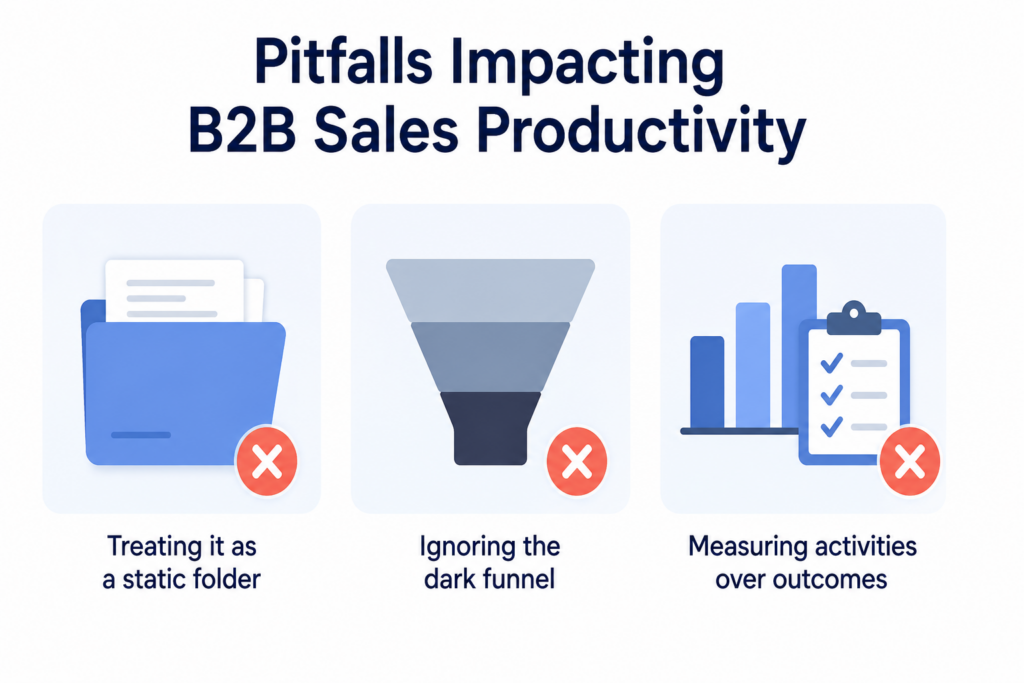
- Treating it as a static folder: Relying on basic cloud storage links where content goes to die.
- Ignoring the dark funnel: Failing to view what prospects are doing anonymously before they talk to sales.
- Measuring activities over outcomes: Tracking how many assets were created instead of tracking pipeline win-rate improvements.
Investing in Advanced Website Visitor Identification Technology
When building your initial enablement function, choose systems that integrate directly into your existing CRM infrastructure. Avoid standalone tools that force your reps to context-switch across multiple tabs throughout the day.
Connecting Content Strategy to Digital Pipelines
To align your enablement strategy with modern purchasing preferences, explore our comprehensive guide on buyer-centric selling in B2B.
Uncovering Signals via Dark Funnel Intent Data
Research by Gartner highlights that 80% of B2B sales interactions will occur through purely digital channels, shifting the focus toward virtual readiness and digital dexterity.
Sales enablement transforms raw marketing content into active deal-acceleration assets, allowing your sales team to match the fast-moving digital journey of modern enterprise buyers.
2. Building a Revenue Enablement Framework
Building a successful revenue enablement framework requires aligning your content creation, onboarding programs, conversation intelligence, and digital collaboration tools with the actual steps of the buyer’s journey. Rather than focusing strictly on sales tactics, an effective framework acts as an operational bridge that monitors real-time intent data to eliminate friction and build buyer confidence.
A modern framework breaks down into four essential layers that support your reps at every phase of the sales cycle:
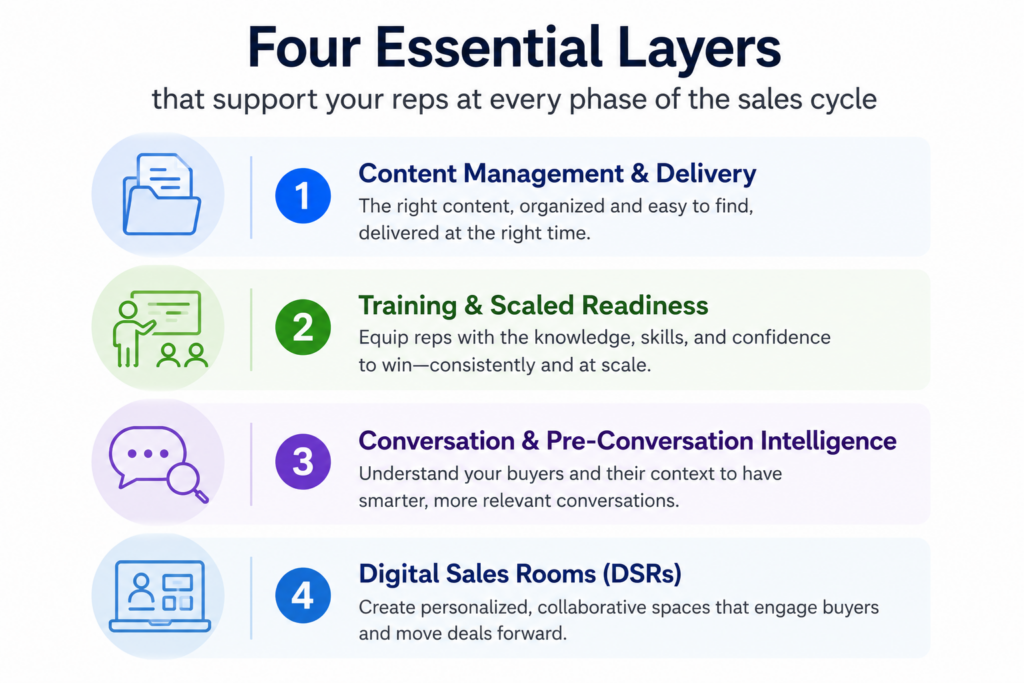
- Content Management & Delivery: Organizing, personalizing, and serving relevant collateral directly within the seller’s workflow.
- Training & Scaled Readiness: Providing continuous, bite-sized onboarding and interactive role-play modules.
- Conversation & Pre-Conversation Intelligence: Tracking sales calls alongside early anonymous website touchpoints to uncover deep intent signals.
- Digital Sales Rooms (DSRs): Utilizing secure, branded collaborative portals where buyers and sellers view shared documentation together.
Common Mistakes
- Siloing enablement in sales: Excluding marketing or customer success teams from the operational loop.
- Overloading reps: Delivering massive, multi-hour training courses rather than just-in-time, accessible learning chunks.
Implementing High-Conversion Sales Content Strategy Blueprints
An IT and Managed Service Provider (MSP) notices their sales cycles are stalling during technical reviews. By updating their framework to include automated Digital Sales Rooms, reps can invite multiple stakeholders into a single workspace, allowing them to track which decision-makers have reviewed compliance terms.
Resolving Structural Friction to Maximise B2B Sales Productivity
- Siloing enablement in sales: Excluding marketing or customer success teams from the operational loop.
- Overloading reps: Delivering massive, multi-hour training courses rather than just-in-time, accessible learning chunks.
Deploying Website Visitor Identification for Sales Readiness
Prioritise systems that offer advanced document tracking features. Knowing exactly which pages of a proposal a prospect reviewed helps your reps focus their follow-up conversations effectively.
Navigating Complex Accounts with Target Market Intent Insights
Understanding how stakeholder groups form opinions is vital; learn more about navigating internal corporate dynamics in our overview of B2B purchase decisions.
Capturing Hidden Demand in the Modern Revenue Enablement Framework
According to Forrester’s Revenue Enablement Landscape analysis, top-performing platforms are evaluated on their ability to equip sellers, accelerate readiness, and deliver unified data insights.
An optimal enablement framework connects your team's training directly to clear buyer engagement metrics, replacing guesswork with predictable, data-driven revenue workflows.
3. Measuring the Revenue Impact of Enablement
Measuring sales enablement ROI requires moving away from soft vanity metrics like document views, focusing instead on hard pipeline metrics such as deal velocity, quota attainment, and content revenue attribution. By connecting asset interactions directly to opportunities inside your CRM, you can identify exactly which pieces of content accelerate deals.
To accurately assess the business impact of your sales enablement initiatives, track performance across three primary areas:
- Ramp Time Velocity: How many days it takes a newly hired account executive to reach full quota productivity.
- Asset Attribution: The specific percentage of closed-won opportunities that are engaged with an enablement touchpoint.
- Deal Length Dynamics: Tracking fluctuations in the length of your sales cycle when structured digital collaboration portals are actively used.
Aligning Asset Attribution with a Multi-Channel Sales Content Strategy
A cybersecurity technology business discovers that opportunities using an interactive ROI calculator close 20% faster and achieve a 15% higher average deal size compared to deals relying entirely on static slide decks.
Content Governance Errors that Reduce B2B Sales Productivity
- Focusing on creation numbers: Assuming that creating more collateral automatically equals better sales performance.
- Failing to refresh assets: Leaving old, outdated pricing sheets or case studies active in the system, which hurts brand credibility.
Data Integration Rules for a Scalable Revenue Enablement Framework
Implement software that provides automated dashboard reports linking content use directly to win revenue, which makes it easy to demonstrate concrete business value to executive leadership.
Mapping Content ROI to Website Visitor Identification Touchpoints
To measure every digital interaction across your pipeline accurately, see our technical breakdown of buyer journey analytics and touchpoint measurement.
Quantifying Revenue Velocity Using Dark Funnel Intent Data
Data from 6sense's Buyer Experience Report shows that winning vendors average 16 distinct content touchpoints per stakeholder during a successful enterprise purchase cycle.
Evaluating your enablement strategy based on actual pipeline metrics protects your budget and helps you continually optimise your content engine for maximum commercial return.
Strategic Myths vs. Facts: Unifying Your Sales Content Strategy
- Myth: Sales enablement frameworks are only useful for large enterprise organisations.
- Fact: Small and mid-sized teams see immediate benefits from enablement by automating routine tasks, allowing small teams to successfully compete against larger competitors.
- Myth: Sellers will naturally find and use the best content available.
- Fact: Studies show that up to 65% of marketing-produced content goes completely unused simply because reps cannot easily locate it during live deals.
The Strategic Buying Checklist
Before purchasing a dedicated enablement solution or visitor tracking tool, ensure your choice ticks all of these essential functional boxes:
- Native CRM Integration: Operates directly inside your existing sales workspaces.
- Anonymized Visitor Tracking: Surface early, dark-funnel intent signals from accounts visiting your site.
- Granular Analytics: Tracks specific page views and reading dwell time for shared documents.
- Mobile Optimization: Allows your field or hybrid reps to find and present assets easily from any device.
FAQ
What is the primary difference between sales enablement and revenue enablement?
Sales enablement focuses specifically on preparing front-line sellers with content and training. Revenue enablement expands this focus across marketing, account management, and customer success, ensuring a seamless experience across the entire customer lifecycle.
The Critical Role of website visitor identification fit into sales enablement
Because most buyers research solutions anonymously, visitor identification tools expose early intent signals from target companies, allowing your team to deliver relevant enablement content before a prospect ever fills out a form.
Why do sales teams ignore most marketing assets?
Sellers typically disregard assets because of poor search capabilities, lack of contextual mapping, or because the content focuses too heavily on product features rather than addressing specific buyer challenges.
Can sales enablement tools help reduce new-hire ramp time?
Yes. Providing structured onboarding paths alongside real-time conversational intelligence reduces new-hire ramp times by 40% to 50%.
What role do Digital Sales Rooms play in modern deals?
Digital Sales Rooms serve as a central, secure space where buyers can access content and easily share it with internal decision-makers, helping sellers track real-time deal engagement.
Sales Enablement as a Strategic Imperative
Modern B2B sales enablement is no longer an optional luxury, it is a core operational requirement for navigating complex digital buying journeys. By providing your commercial teams with structured training, contextual content assets, and transparent buyer analytics, you eliminate friction and accelerate your sales pipeline.
Ready to uncover the hidden buying signals across your website? Get in touch to Dynamic Leads to book a live demo and start turning your anonymous traffic into actionable sales pipeline today.