
In the modern digital landscape, scaling a business-to-business (B2B) enterprise requires efficiency, precision, and personalization. At the core of this growth is b2b marketing automation, the strategic use of software platforms and technologies to streamline, automate, and measure marketing tasks and workflows.
Unlike consumer-facing strategies, b2b marketing automation is specifically engineered for complex decision-making units, longer sales cycles, and high-value relationships. By leveraging a modern SaaS marketing technology stack, organizations can build scalable engines that treat target accounts as dynamic entities rather than isolated, anonymous clicks.
1. Core B2B Marketing Automation Benefits for Modern Enterprises
Implementing a dedicated strategy transforms how your revenue teams operate. When evaluating the core benefits of b2b marketing automation, enterprises experience a fundamental shift from reactive campaign execution to proactive pipeline engineering:
- Enhanced Lead Nurturing: Deliver targeted content based on real-time user behavior, guiding prospects smoothly through complex, multi-stage sales funnels.
- Smarter Smarketing (Sales and Marketing Alignment): Establish unified data pipelines so your commercial team receives highly qualified leads (MQLs) at the exact moment purchase intent peaks.
- Data-Driven Decision Making: Access deep analytics on campaign performance, multi-touch customer attribution, and precise return on investment (ROI).
- Resource Efficiency: Eliminate repetitive manual tasks, allowing your growth team to focus on high-level go-to-market strategy and creative execution.
2. Essential Foundations of SaaS Marketing Technology
To build a robust foundation for your b2b marketing automation system, your core framework must look beyond basic email delivery and leverage these essential capabilities:
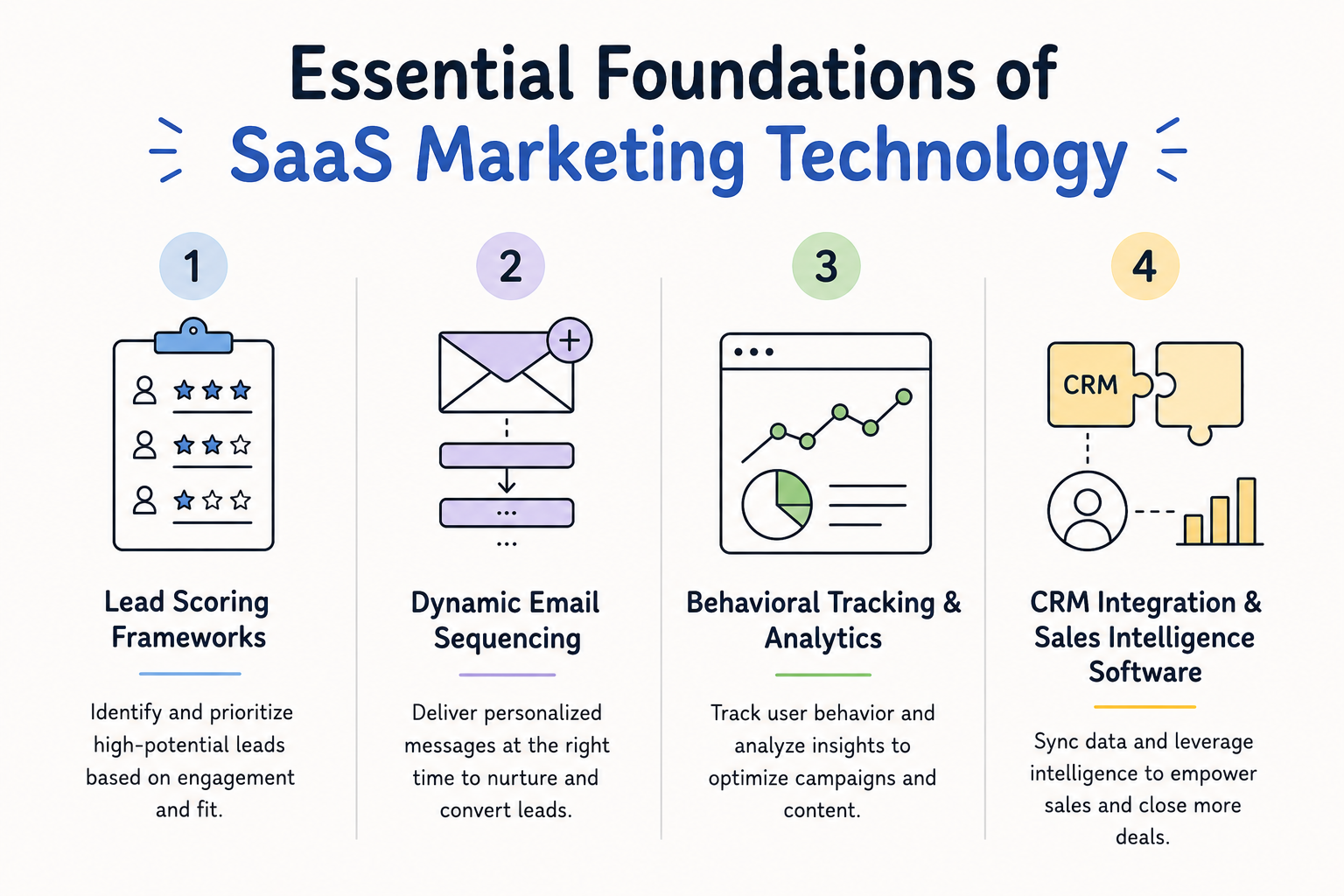
Lead Scoring Frameworks
Assign explicit values to customer interactions to gauge actual purchase intent. For example, viewing a pricing page or downloading a product specification sheet should trigger a higher score than simply reading a top-of-funnel blog post.
Dynamic Email Sequencing
Trigger highly personalized email journeys that adapt fluidly based on how a prospect interacts with your digital assets. If a lead clicks a link about workflow integration, their subsequent sequence in your b2b marketing automation system should automatically shift to technical validation content.
Behavioral Tracking & Analytics
Monitor how target accounts interact with your website, emails, and content pillars across the web. This requires cross-channel tracking that unifies anonymous web visits with known contact profiles once a form is submitted.
CRM Integration & Sales Intelligence Software
Ensure a bidirectional, real-time flow of data between your b2b marketing automation platform (e.g., HubSpot, Marketo) and your sales CRM (e.g., Salesforce). Integrating robust sales intelligence software enrichments ensures that your sales reps have deep contextual data, such as technology stacks used, funding rounds, and hiring trends, before they ever make a discovery call.
3. Deep Dive: Building an Automated Lead Scoring Matrix
To transition from arbitrary lead handoffs to data-backed pipeline generation, organizations must deploy a balanced lead scoring matrix. A successful matrix combines implicit behavioral signals with explicit demographic profile data.
4. Operational Blueprints for B2B Lead Generation Software
A cornerstone of modern B2B lead generation software is the ability to build conditional logic sequences. Below are two foundational workflow blueprints to deploy within your b2b marketing automation platform.
5. Step-by-Step Implementation Strategy
Successfully launching an automated pillar campaign requires a structured, phase-based approach:
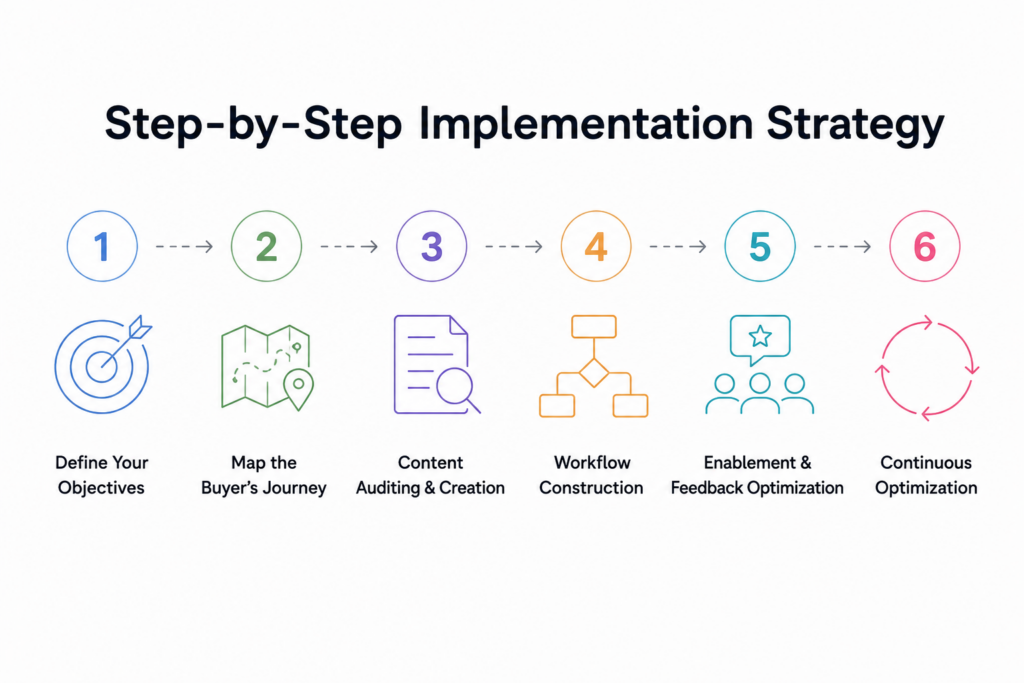
- Define Your Objectives: Establish clear Key Performance Indicators (KPIs), such as accelerating pipeline velocity, reducing customer acquisition costs (CAC), or increasing conversion rates from lead to opportunity.
- Map the Buyer’s Journey: Identify the exact informational questions your ideal customer profiles (ICPs) ask at the Awareness, Consideration, and Decision stages.
- Content Auditing & Creation: Ensure you have the necessary technical whitepapers, quantitative case studies, and interactive calculation templates to fuel your automated tracks.
- Workflow Construction: Build standard operating workflows in your SaaS marketing technology suite, starting with simple welcome series before graduating to multi-branch behavioral triggers.
- Enablement & Feedback Optimization: To guarantee that revenue teams can successfully convert the automated pipeline, establish a closed-loop enablement framework that links incoming data signals to immediate sales behavior modifications.
- Continuous Optimization: Regularly running A/B tests on email subject lines, landing page form lengths, and lead scoring thresholds prevents systemic pipeline stagnation.
6. Future Trends in B2B Automation
The landscape is shifting rapidly as organizations move away from legacy, generic batch-and-blast methodologies. Forward-thinking enterprise brands utilizing b2b marketing automation should prepare for:
Account-Based Marketing (ABM) Automation: Scaling highly customized, synchronized ad and email campaigns tailored specifically to high-value target accounts rather than individual leads.gh-value target accounts rather than individual leads.Explore Related Resources
Privacy-First Data Practices: Adapting tracking structures to comply with tightening global data privacy standards (GDPR, CCPA) while maintaining data integrity through first-party data ecosystems.
Hyper-Personalization via Predictive Analytics: Moving past basic token optimization (like changing a first name tag) to dynamically serve entirely unique layout variations and case studies based on predicted account needs.
- Sales Enablement Content: Discover the foundational assets needed to fuel buyer engagement across your entire commercial pipeline: Sales Enablement Content Every Team Needs.
- GTM Alignment: Learn how to unite your revenue teams under shared metrics and goals: Sales and Marketing Alignment.
- De-anonymizing Traffic: Uncover how to identify hidden intent signals from your site traffic before forms are even filled out: B2B Sales Enablement Guide.
- Future-Proofing Sales: Dive into how machine learning and modern tools are reshaping go-to-market execution: AI Sales Enablement Trends.
Industry Insights & Deep Dives
- Forrester: For deep operational benchmarks regarding role-specific enablement, team efficiency, and bridging the gap between what marketing produces and what reps require, read Forrester's Insights on Sales Enablement & Strategy Planning.
- Gartner: To understand how to properly map sales content to evolving B2B buying behaviors while balancing AI opportunities, explore Gartner's Ultimate Guide to Sales Enablement Strategy.
- 6sense: For a deep dive into breaking down silos, shifting away from outdated MQL models, and prioritizing high-fit, in-market target accounts, check out The Comprehensive Guide to Sales and Marketing Alignment by 6sense.
FAQ Section
What is the main difference between B2B and B2C marketing automation?
B2B automation focuses on managing longer sales cycles, navigating complex decision-making units, and building high-value relationships. B2C automation usually targets immediate, individual, and transactional conversions.
How does a lead scoring matrix prevent bad leads from reaching sales?
It filters leads by assigning point values to positive interactions and deducting points for negative traits. For instance, jobs containing "Student" or "Intern" lose 30 points, while inactivity drops 10 points, keeping low-intent contacts below the sales-ready threshold.
What happens when a prospect reaches the lead scoring threshold?
Once a prospect accumulates 70 or more points, the system automatically updates their status to a Marketing Qualified Lead (MQL). It then instantly syncs their interaction history to the CRM so sales reps can follow up immediately.
Why does Blueprint B skip sending automated emails if a rep is already assigned?
If a prospect is already working with a sales rep, sending an automated generic email can disrupt the human relationship. Instead, the system alerts the assigned Account Executive in real time so they can reach out personally.
What is predictive hyper-personalization in marketing automation?
It moves beyond simple text swaps like first names. Predictive hyper-personalization uses data analytics to dynamically alter entire page layouts, asset offers, and case studies based on what the system expects the specific account needs next.
Key Takeaways: Engineering Your Revenue Engine
Modern b2b marketing automation is no longer a luxury reserved for massive tech conglomerates; it is the infrastructure required to stay competitive in a digital-first marketplace. Transitioning from scattered manual execution to a centralized, logic-driven ecosystem allows your marketing and sales departments to scale high-touch relationships without a linear increase in overhead.
The ultimate measure of a successful automation engine is not the complexity of its workflows, but the velocity and quality of the pipeline it generates. By establishing clear data governance, prioritizing tight alignment between internal teams, and relentlessly tracking account behavior, your SaaS marketing technology stack will transform from a cost center into a reliable revenue driver.