

The modern B2B buying ecosystem does not move in a straight line. Prospective accounts rarely download a single whitepaper and immediately jump on a sales call. Instead, their paths meander through months of anonymous research, fragmented content consumption, and dark social recommendations long before they ever fill out a form.
If your marketing team relies entirely on where a lead last clicked before converting, you are missing the vast majority of the story. To scale predictable pipelines, modern enterprise organisations, B2B SaaS providers, and marketing agencies must master buyer journey analytics. This practice goes far beyond surface-level tracking, offering deep visibility into every single digital footprint an account leaves behind so you can effortlessly track customer touchpoints.
1. The Anatomy of a multi-touch journey Journey: How to Track Customer Touchpoints
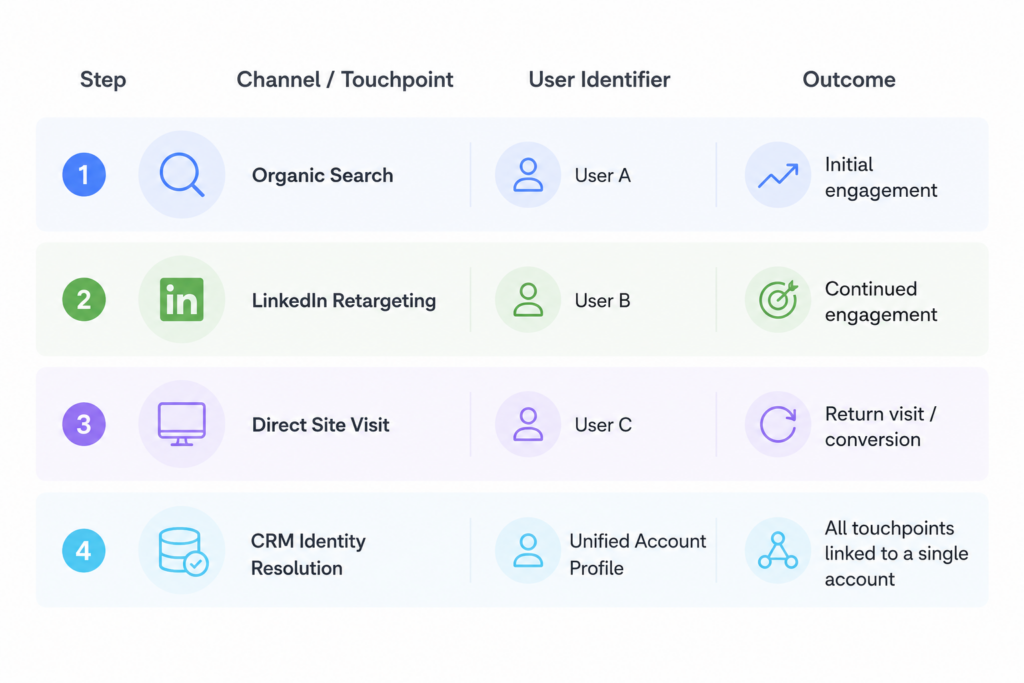
A modern B2B buyer journey is a complex, multi-layered framework consisting of multiple decision-makers interacting with a brand across independent digital channels over an extended period. Measuring this journey accurately requires moving away from individual contact tracking and embracing account-based identity resolution. This ensures that every anonymous visit, content download, and email interaction is mapped to a single unified corporate profile.
The Breakdown of Non-Linear Paths
In the B2B tech, cybersecurity, and industrial manufacturing sectors, a sales cycle can span from three to twelve months. During this window, This reflects what industry research describes as B2B buying networks, where multiple decision-makers collectively influence purchasing outcomes rather than a single buyer.
Without proper analytic frameworks, these look like three completely unrelated actions. In reality, they represent a singular, coordinated corporate evaluation path.
Strategic Blindspots to Neutralise
- Tracking individuals instead of accounts: Missing the connection between different colleagues within the same target company.
- Ignoring the dark funnel: Many organisations underestimate why B2B buyers go dark, assuming prospects have lost interest when they're actually continuing their research through peer recommendations, review sites, and private conversations.
Commercial Optimization Advice
To effectively capture this web of interactions, deploy tracking systems that record both user-level cookies and company-level network signatures. This allows you to build an aggregate intent score for target accounts before an explicit form submission occurs.
Discover how our foundational platform surfaces hidden accounts on our core Dynamic Leads Home Page.
2. Advanced Frameworks for B2B Marketing Attribution
Choosing an attribution model requires aligning your data architecture with your actual sales cycle length and touchpoint density. While single-touch metrics oversimplify performance, multi-touch frameworks like Time-Decay, W-Shaped, or Full-Path models distribute financial credit across the entire pipeline. This offers a clear picture of what initiates, nurtures, and ultimately closes complex B2B deals.
Deep Dive into Attribution Structures
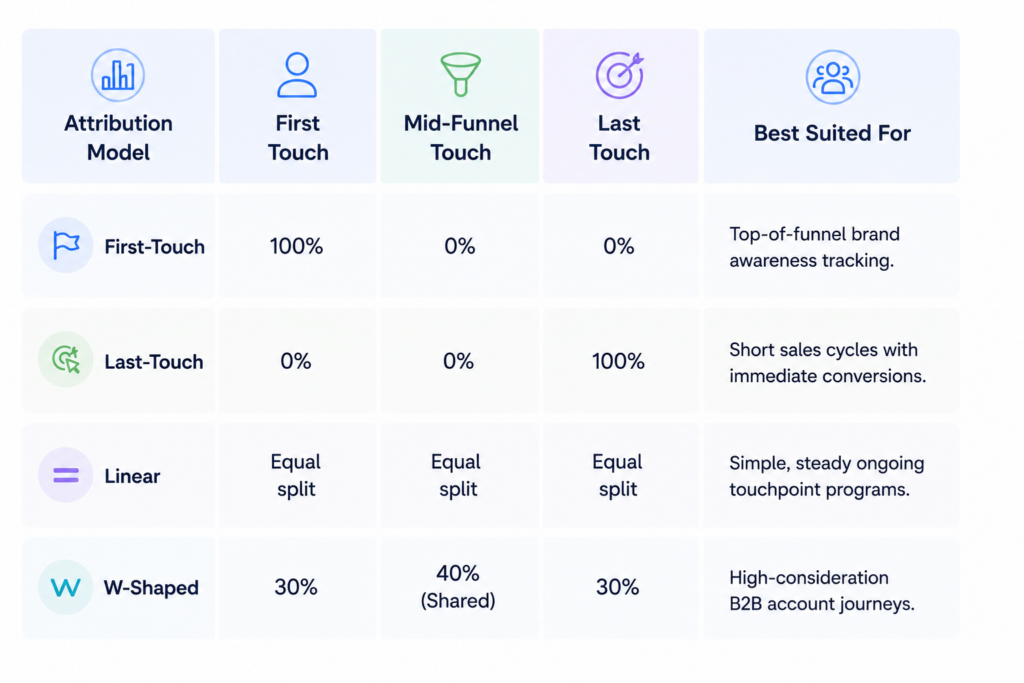
Selecting the correct model drastically alters where your budget goes. Let's compare how different models distribute credit across an identical journey:
The Value of Multi-Touch Attribution Models (W-Shaped)
For most SaaS, MSPs, and agency models, the W-Shaped Attribution Model provides the highest balance of clarity. It awards 30% of the revenue credit to the first touchpoint (discovery), 30% to the lead creation touchpoint (mid-funnel conversion), and 30% to the opportunity creation touchpoint (sales validation). The remaining 10% is distributed evenly among the minor intermediary touches.
Strategic Buying Advice
When investing in analytics tech or setting up internal operational dashboards, verify that your stack supports dynamic, multi-touch custom models. Avoid software that locks you permanently into rigid first- or last-click systems.
3. Deploying Website Visitor Identification Software
Website visitor identification fills a critical gap in buyer journey analytics by unmasking anonymous corporate traffic before users fill out a contact form. By cross-referencing incoming IP addresses and network domains against global firmographic databases, this technology identifies exactly which companies are researching your products, allowing sales teams to target active accounts early in their evaluation process.
Monetising Anonymous Website Engagement
Up to 98% of your website visitors will leave your site without ever converting via a standard form. In traditional analytics setups, this traffic registers as generic, valueless numbers. With real-time visitor identification, however, you gain immediate clarity:
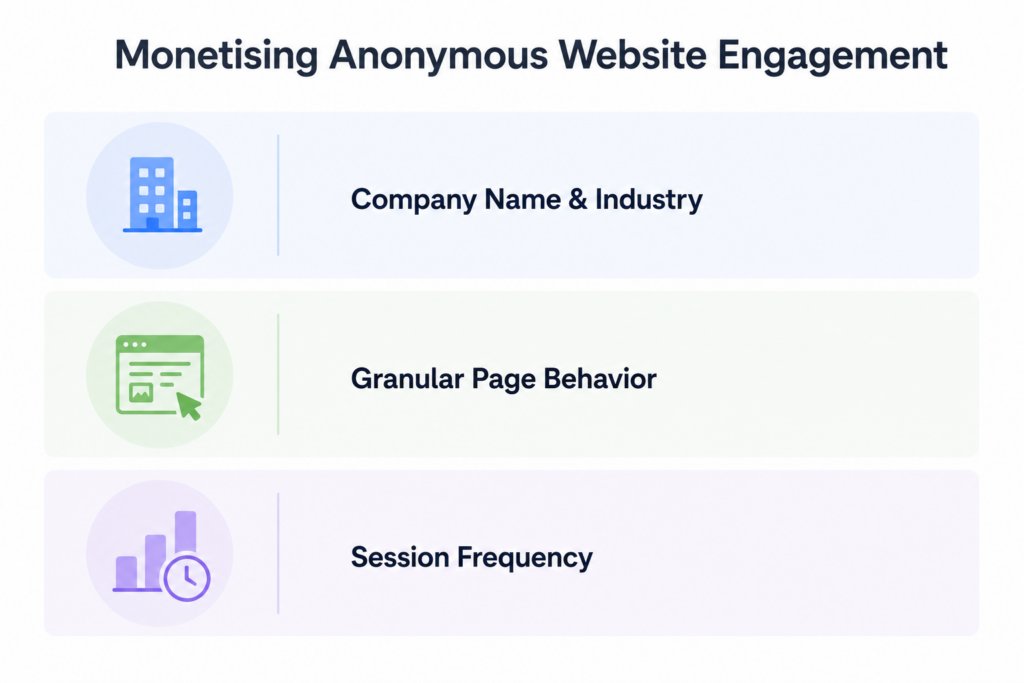
- Company Name & Industry: Instantly see if a premier cybersecurity firm or a legacy manufacturer is browsing your pricing pages.
- Granular Page Behavior: Track the exact sequence of technical documentation, case studies, and feature tables they consumed.
- Session Frequency: Measure how often multiple distinct users from that same domain return to your digital ecosystem.
Common Implementation Mistakes
Many organizations purchase advanced identification tools but leave the data siloed within marketing team reports. If your business development reps (BDRs) do not have automated, real-time access to these intent signals inside your CRM, your outbound execution will lag far behind your buyer's actual timeline.
4. Step-by-Step: Setting Up an Actionable Tracking Framework
Setting up a robust buyer journey analytics framework requires unifying your data collection, identifying accounts cleanly, and syncing analytics directly with your CRM. By implementing consistent tracking parameters and automated alerts, revenue teams can move away from fragmented data pools and establish an accurate, single source of truth for all cross-channel pipeline growth.
To build an institutional-grade tracking workflow that supports complex B2B sales development cycles, execute the following steps in sequence:
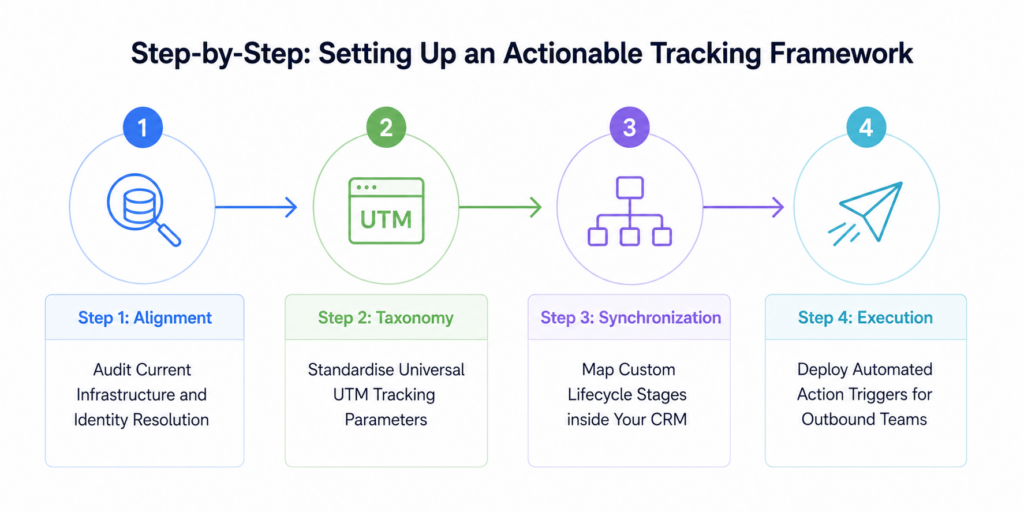
1.Audit Current Infrastructure and Identity Resolution:
Step 1: Alignment.
Verify that all corporate tracking pixels, tag managers, and reverse IP identification scripts are placed globally across all subdomains and landing page variants. Clean out duplicate tag instances to preserve loading speeds.
2.Standardise Universal UTM Tracking Parameters:
Step 2: Taxonomy.
Enforce a strict, team-wide naming convention for all inbound links. Every paid campaign, organic social post, email broadcast, and partner link must utilize consistent lowercase tags for source, medium, campaign, and content variables.
3.Map Custom Lifecycle Stages inside Your CRM:
Step 3: Synchronization.
Align marketing automation milestones directly with your sales pipeline stages. Ensure that transitions from Anonymous Prospect to Marketing Qualified Account (MQA), and finally to Sales Discovered Opportunity, update cleanly across systems.
4.Deploy Automated Action Triggers for Outbound Teams:
Step 4: Execution.
Configure automated Slack or CRM notifications that alert dedicated account managers when a high-value, unmasked target account visits high-intent pages (such as your pricing grid or implementation documentation) more than three times within a single week.Automated alerts are most effective when paired with strategic prospecting outreach, enabling sales teams to engage accounts while purchase intent is at its highest.
Debunking Common Attribution Misconceptions
- Myth: "Google Analytics provides all the multi-touch attribution data a B2B firm needs."
- Fact: Standard web analytics tools focus heavily on individual user sessions and struggle to naturally bridge multiple independent corporate stakeholders into a singular account profile over a long sales cycle.
- Myth: "Form fills are the only accurate way to score active commercial interest."
- Fact: Deep content consumption patterns combined with high company-wide repeat visits from unmasked domains often represent far stronger buying intent than a single accidental asset download.
Frequently Asked Questions
What is the primary difference between customer journey mapping and buyer journey analytics?
Customer journey mapping is a conceptual, visual design exercise that outlines the ideal paths a hypothetical buyer might take. Buyer journey analytics is the real-time, data-driven measurement of actual interactions, tracing hard metrics and touchpoints across active accounts to validate or correct those assumptions.
How does cookie-less tracking affect modern multi-touch measurement?
As traditional third-party cookies phase out, analytics systems must rely on first-party data capture, reverse IP firmographic lookups, and server-side tracking configurations to maintain accurate account histories without violating user privacy rules.
Can buyer journey analytics track dark social engagement?
While it cannot read private Slack messages or personal direct messages, buyer journey analytics captures the immediate downstream effects. When a dark social link brings an executive to your site anonymously, advanced visitor identification unmasks their company, helping you correlate external activity with sudden spikes in targeted accounts.
How often should our attribution weights be adjusted?
Attribution model weights should remain consistent for at least two to three complete sales cycles to gather a statistically sound baseline. Adjust weights only when your go-to-market strategy shifts dramatically, such as transitioning from an inbound strategy to an Account-Based Marketing (ABM) model.
Is reverse IP lookup tracking fully compliant with GDPR regulations?
Yes. Professional corporate visitor identification platforms process corporate IP data to identify the legal business entity rather than tracking specific, individual personal information. This maintains compliance with UK GDPR and PECR frameworks when configured correctly.
The Path to Complete Pipeline Visibility
Mastering buyer journey analytics changes how B2B leaders deploy capital, align revenue operations, and scale their organizations. When you lift the veil on anonymous web traffic and accurately attribute revenue to the touchpoints that matter, you eliminate guesswork entirely.
Stop allowing high-value enterprise intent to slip through the cracks unnoticed. Book an expert platform consultation today to see how you can accurately track every single critical touchpoint across your pipeline.
Go to Dynamic Leads to book a live demo and start turning your anonymous traffic into actionable sales pipeline today.