
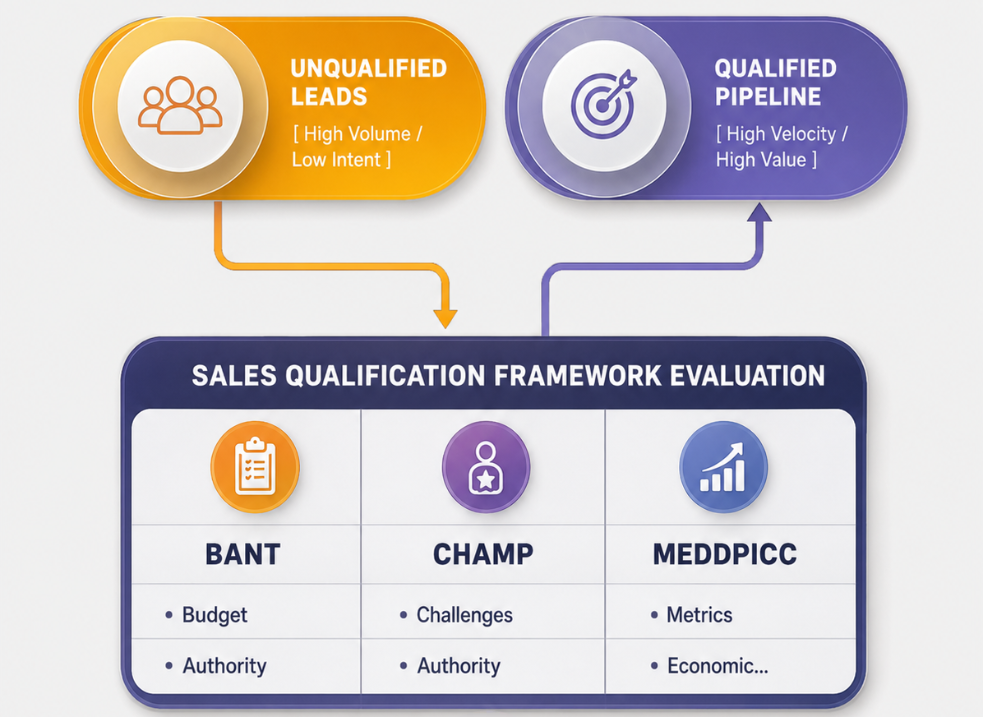
Unqualified leads consume valuable sales resources, drag down pipeline velocity, and diminish overall win rates across high-growth teams. When your B2B sales process lacks a rigorous qualification model, account executives waste endless hours chasing prospects who lack genuine buying intent or financial capacity. Implementing the right qualification criteria transforms your entire go-to-market execution, ensuring your team focuses exclusively on revenue-ready accounts.
Traditional vs Modern Sales Qualification Frameworks
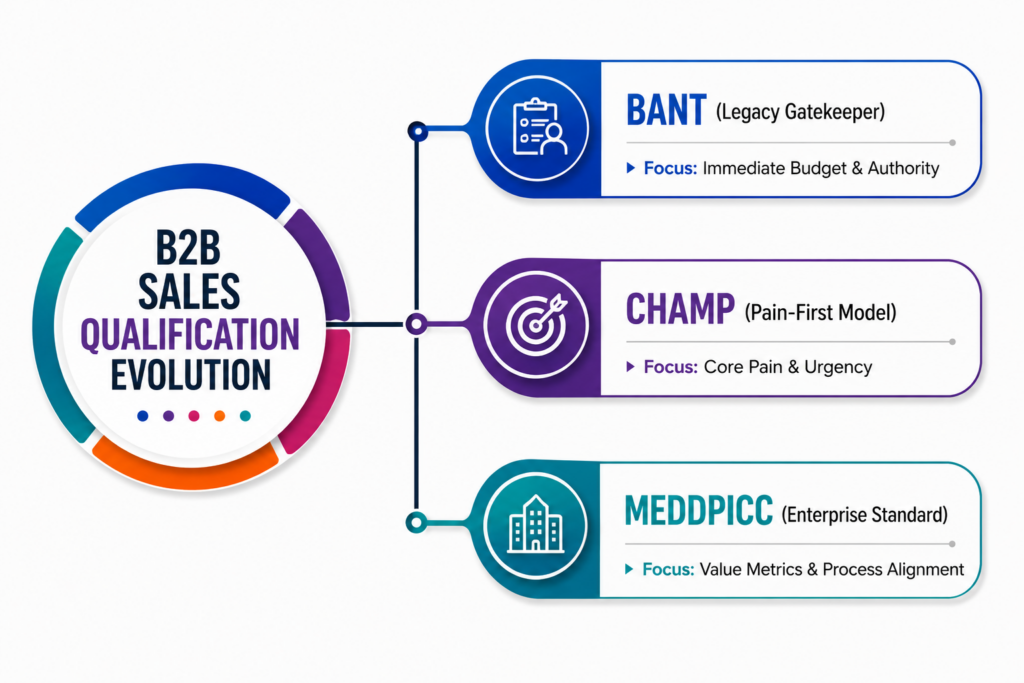
Modern sales qualification frameworks compared against legacy models show a decisive shift from strict budget gating to deep value alignment, buyer pain analysis, and verified intent data. While legacy frameworks prioritise immediate purchasing power, contemporary methodologies evaluate complex stakeholder dynamics, decision metrics, and real-time digital behaviour to maximise conversion efficiency.
Mastering the B2B Sales Process
A scalable B2B sales process relies on aligning your go-to-market execution with how modern buyers make purchasing decisions. Rather than treating discovery as a passive checklist, high-performing revenue teams structure their pipeline around verified buyer milestones.
Legacy frameworks like BANT established the foundation for modern deal evaluation. However, buyer behaviour in the B2B tech sector has evolved dramatically. Today, decision-making involves large buying committees, prolonged evaluation phases, and extensive self-guided research prior to speaking with a sales representative.
Modern qualification relies on uncovering hidden organisational pain and quantifying business impact. Waiting for a prospect to state a confirmed budget upfront often leads to missed opportunities. Modern RevOps teams prioritise buyer intent data and early engagement signals over arbitrary budget checklists.
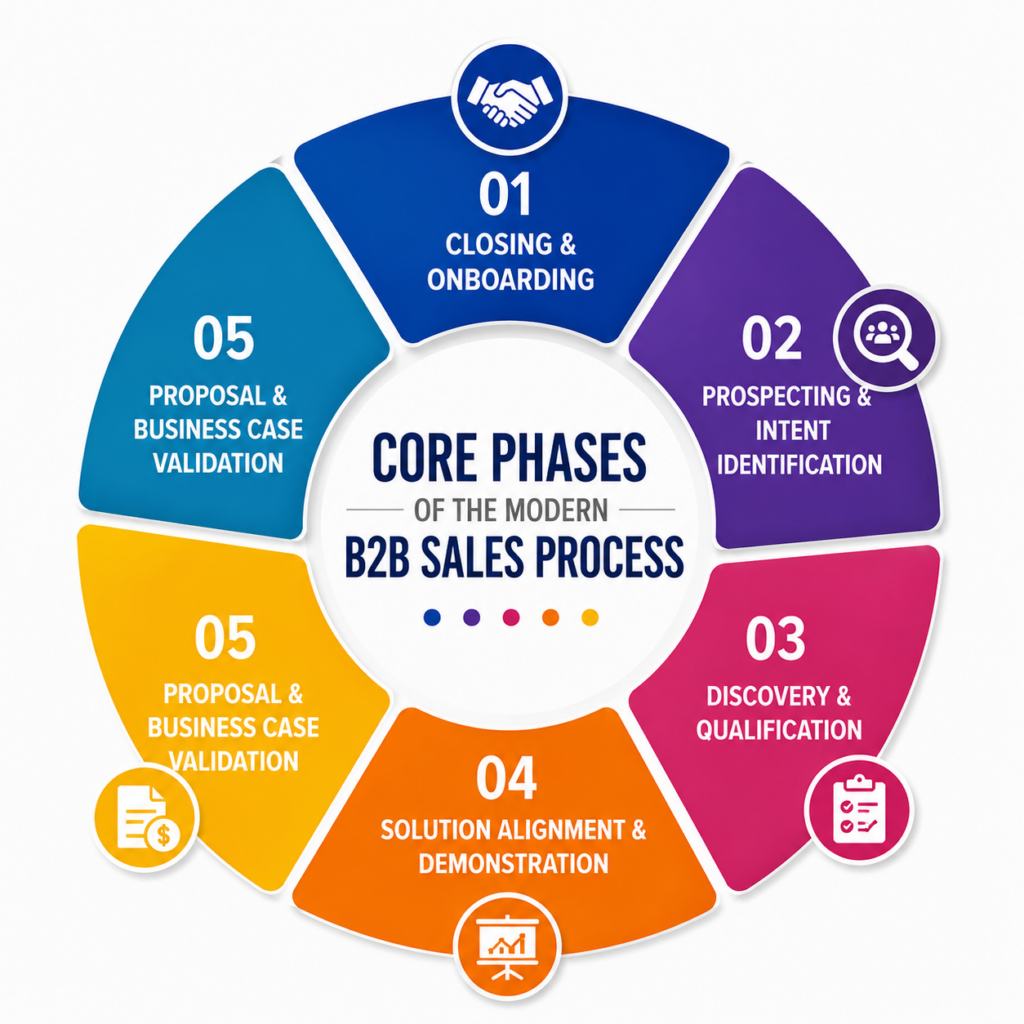
Core Phases of the Modern B2B Sales Process
- Prospecting & Intent Identification: Capturing early digital signals before the initial touchpoint.
- Discovery & Qualification: Evaluating mutual fit, urgency, and organisational capacity.
- Solution Alignment & Demonstration: Mapping product capabilities directly to quantified pain points.
- Proposal & Business Case Validation: Securing alignment across the buying committee and economic stakeholders.
- Closing & Onboarding: Navigating procurement, paper processes, and initial customer handoff.
Sales Qualification Frameworks Compared
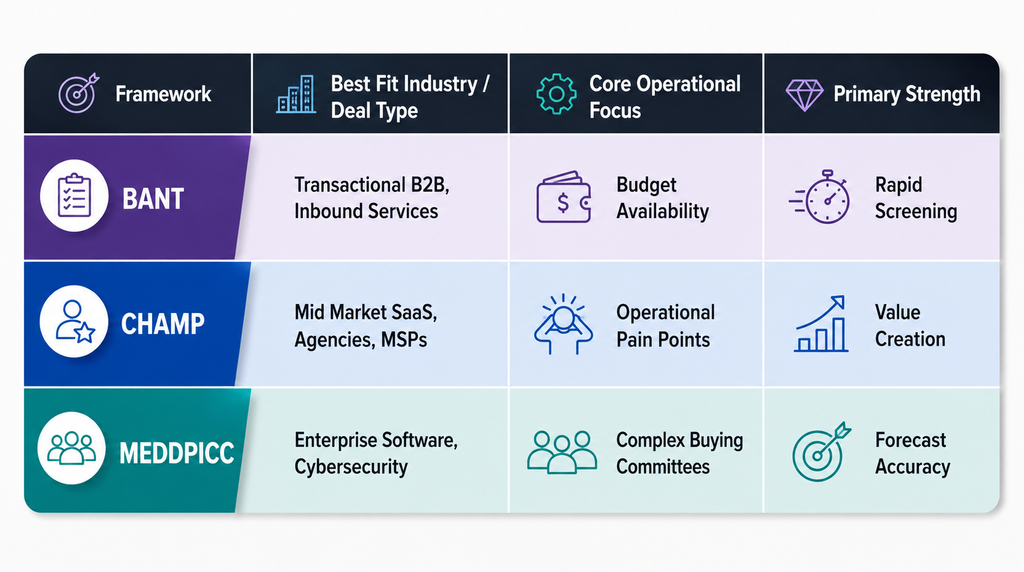
BANT screens for upfront budget, CHAMP leads with customer pain, and MEDDPICC manages complex enterprise buying processes.
BANT fits quick transactional sales, CHAMP suits mid-market SaaS, and MEDDPICC dominates multi-stakeholder enterprise deals. Choosing the right one ensures reps focus only on revenue-ready leads.
Comparative Breakdown: BANT vs CHAMP vs MEDDPICC
Evaluating sales qualification frameworks compared across operational environments reveals distinct advantages: BANT suits transactional deals, CHAMP empowers pain-led mid-market conversations, and MEDDPICC dominates complex enterprise environments with intricate purchasing processes. Selecting the correct model ensures optimal resource allocation across your entire sales organisation.
BANT (Budget, Authority, Need, Timeline)
BANT works best for transactional B2B sales cycles with quick decision loops. It acts as an efficient filter but often screens out early stage accounts that have acute pain but unallocated budgets.
CHAMP (CHallenges, Authority, Money, Prioritization)
CHAMP flips traditional qualification by placing customer pain at the core of the conversation. By addressing challenges first, reps establish immediate value before evaluating budgetary constraints.
- CHallenges: What fundamental operational friction is the buyer attempting to resolve?
- Authority: Who has the organisational power to drive internal change?
- Money: Does the return on investment justify allocating fresh budget?
- Prioritisation: Where does this initiative rank among competing operational goals?
MEDDPICC (Metrics, Economic Buyer, Decision Criteria, Decision Process, Paper Process, Identify Pain, Champion, Competition)
MEDDPICC is the gold standard for enterprise sales intelligence software selling into multi-stakeholder organisations. It provides granular visibility into complex buying committees, paper processes, and competitive positioning.ular visibility into complex buying committees, paper processes, and competitive positioning.
Integrating Intent Data into Your Sales Qualification Framework
Integrating website visitor identification and buyer intent data directly into sales qualification frameworks compared across industries drastically shortens discovery cycles, validates prospect engagement, and empowers reps to qualify opportunities long before the initial discovery call occurs.
Standard qualification relies heavily on self-reported prospect information. Introducing real-time intent data from platforms like Dynamic Leads validates actual interest based on digital footprint analytics. When your revenue team identifies which target accounts visit pricing pages, review implementation guides, or research specific service capabilities, qualification transitions from passive questioning to active confirmation.
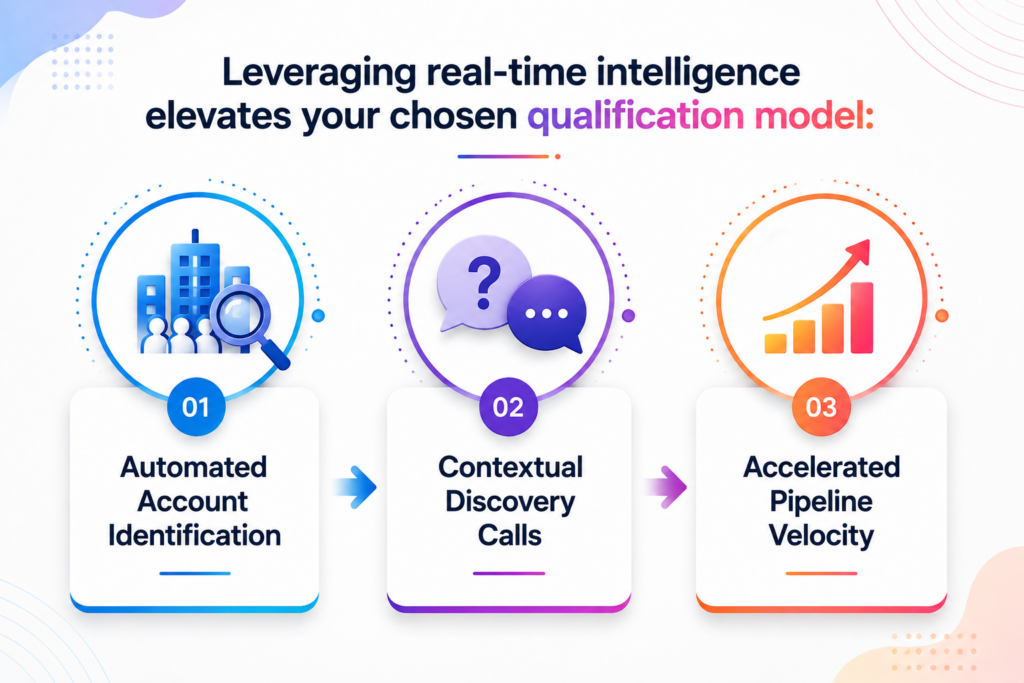
Leveraging real-time intelligence elevates your chosen qualification model:
- Automated Account Identification: Match anonymous web visitors to ICP accounts instantly.
- Contextual Discovery Calls: Tailor qualification questions based on exact pages viewed.
- Accelerated Pipeline Velocity: Prioritise prospects demonstrating active buyer intent.
Frequently Asked Questions
Which sales qualification framework is best for B2B SaaS?
CHAMP and MEDDPICC are ideal for B2B SaaS companies. CHAMP excels in mid-market deals by focusing on customer pain, while MEDDPICC provides the structure required to navigate enterprise procurement processes, decision criteria, and complex buying committees.
Why does the traditional BANT framework fail modern sales teams?
BANT fails modern sales teams because buyers research solutions before setting formal budgets. Requiring an explicit budget upfront disqualifies high-potential accounts that would reallocate funds once clear value and return on investment are demonstrated during discovery.
How does intent data improve pipeline velocity?
Intent data improves pipeline velocity by revealing active purchasing research in real-time. Sales representatives prioritise accounts actively evaluating solutions, enabling timely contextual engagement that shortens discovery phases and speeds up deal progression through the pipeline.
Can you combine different sales qualification frameworks?
Yes, high-performing RevOps teams often combine frameworks. A common strategy involves using CHAMP for initial lead discovery calls while applying MEDDPICC criteria for ongoing opportunity management and deal forecasting across multi-month enterprise sales cycles.
Conclusion
Choosing the right qualification model transforms your sales team from passive order takers into high-converting revenue producers. Whether you deploy CHAMP for pain-led discovery or MEDDPICC for complex enterprise deals, structuring your B2B sales process around clear qualification criteria drives predictable growth. Combining proven methodologies with real-time buyer intent data ensures your account executives spend time exclusively on high-value, revenue-ready opportunities..
Ready to supercharge your B2B sales process with actionable buyer intent data? Start your free trial with Dynamic Leads today and convert hidden website traffic into qualified pipeline.