

Measuring return on investment in the business to business sector remains one of the trickiest challenges for modern growth leaders. When sales cycles stretch over six to twelve months and involve dozens of decision makers, connecting early campaign touchpoints to final revenue feels nearly impossible. Failing to accurately measure B2B marketing ROI leads directly to wasted ad spend, misallocated budgets, and friction between sales and marketing teams. To build a predictable revenue engine, you need a clear framework that connects raw engagement data to actual bottom line profit.
What is B2B Marketing ROI and How Do You Calculate It?
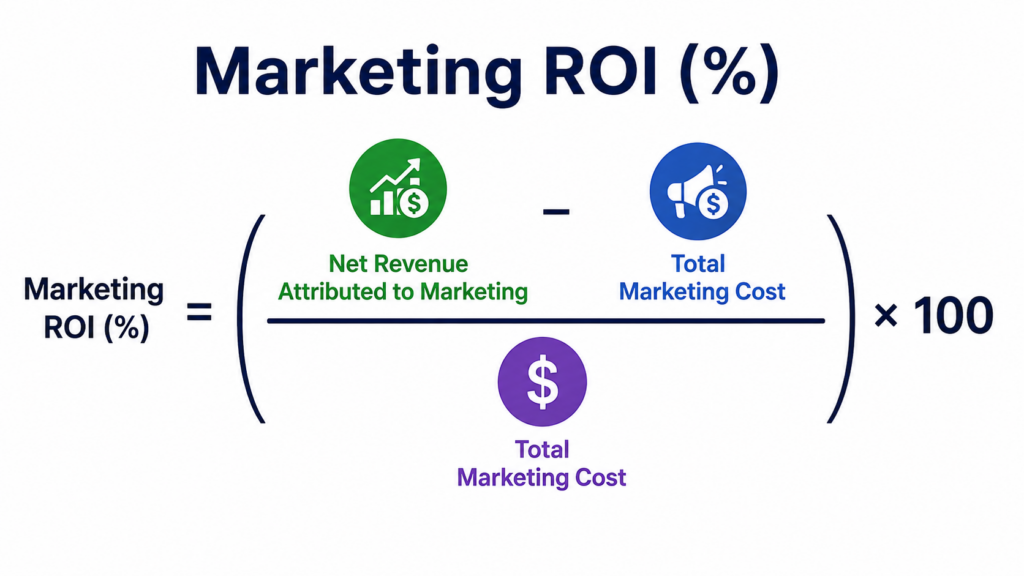
B2B marketing ROI is the quantitative measure of net revenue generated by marketing activities divided by the total cost of those marketing initiatives. Calculating this metric accurately requires accounting for all software subscriptions, ad spend, agency retainers, and team overheads relative to closed won contract values over time.
To calculate your baseline return, use the foundational B2B marketing ROI metrics formula:
Calculating total expenditure demands absolute transparency. You must factor in:
- Direct Campaign Costs: Paid ad spend, event sponsorships, and content creation fees.
- Technology Stack Expenses: CRM software, email automation platforms, and website visitor identification tools.
- Headcount Overhead: Internal team salaries and external agency retainers.
For instance, if your campaign spending totals £50,000 across a quarter and generates £250,000 in gross margin from new accounts, your net profit is £200,000. Applying the formula yields a 400% return on investment.
Core B2B Marketing ROI Metrics Every Growth Leader Must Track
The primary metrics required to measure B2B marketing ROI effectively include Customer Acquisition Cost, Customer Lifetime Value, and Pipeline Velocity. Tracking these metrics alongside marketing attribution models provides a comprehensive view of budget efficiency, channel profitability, and long term deal value generation.
Relying exclusively on surface level indicators like clicks or form fills damages revenue growth. High performing teams focus on core metrics that directly reflect financial health:
- Customer Acquisition Cost (CAC): The total expenditure required to secure a single new client. Lowering CAC while maintaining account quality increases profitability.
- Customer Lifetime Value (LTV): The total projected revenue a business expects from a single account over its entire lifespan. A healthy ratio features an LTV at least three times higher than CAC.
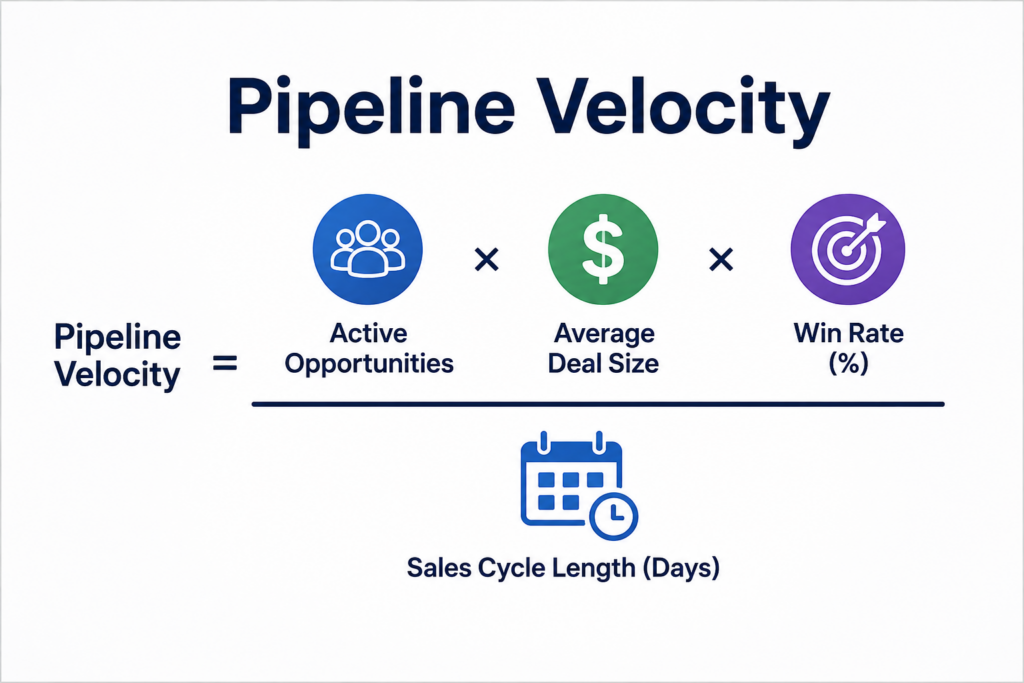
- Pipeline Velocity: The speed at which prospects move through your deal stages into closed won revenue. It measures real time revenue momentum using four variables:
Combining these metrics gives RevOps leaders complete clarity on commercial efficiency.
Advanced Marketing Attribution Models to Measure B2B ROI
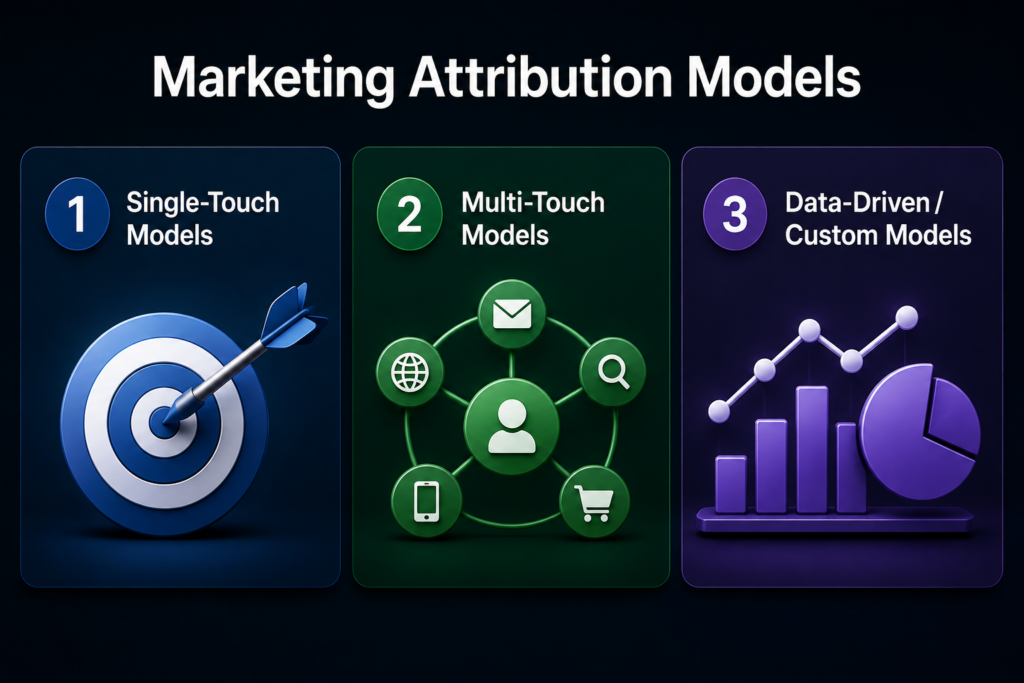
Choosing the right marketing attribution models enables B2B organizations to assign financial credit to specific touchpoints across extended buying journeys. Multi touch attribution models distribute revenue credit proportionately across first touch awareness, lead creation, and final deal closure for total channel accuracy.
Marketing Attribution Models
- Single-Touch Models
First-Touch Attribution: Attributes 100% of the conversion credit to the very first point of contact. Best for understanding top-of-funnel brand awareness drivers.
Last-Touch Attribution: Attributes 100% of the credit to the final touchpoint before conversion. Simple to track, but ignores all prior nurturing efforts. - Multi-Touch Models
Linear: Distributes credit equally across all touchpoints along the customer journey.
Time-Decay: Gives exponentially more credit to touchpoints that occurred closer to the time of conversion. Great for longer sales cycles.
U-Shaped (Position-Based): Assigns 40% of credit to the first touch, 40% to the lead-creation touch, and splits the remaining 20% across middle touchpoints.
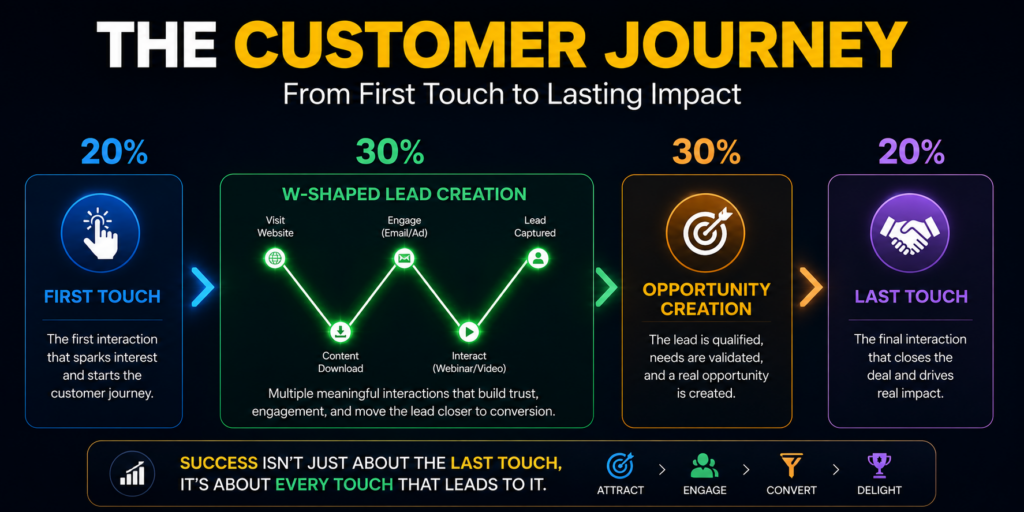
W-Shaped: Tailored for complex B2B pipelines, splits 90% of credit equally between first touch, lead creation, and opportunity creation, distributing 10% to middle touchpoints. - Data-Driven / Custom Models
Algorithmic Attribution: Uses machine learning to evaluate historical customer journeys and calculate the true statistical impact of each channel.
Single touch models like first touch or last touch miss the complex reality of B2B buying committees. Implementing advanced tracking ensures every impactful channel receives accurate attribution credit:
- Linear Attribution: Distributes equal revenue credit to every interaction along the buyer journey. It offers a simple start but lacks nuanced insights.
- W-Shaped Attribution: Allocates 30% of credit to the initial touchpoint, 30% to lead creation, and 30% to opportunity creation, reserving the remaining 10% for intermediate nurture steps.
- Time-Decay Attribution: Weights touchpoints closer to the deal closure heavier than initial interactions, making it ideal for lengthy sales pipelines.
Using automated buyer intelligence tools simplifies attribution by tracking anonymous site activity long before a form submission occurs.
Pipeline Velocity and Website Visitor Identification
Pipeline velocity measures how quickly prospects move through your sales funnel and generate revenue. By integrating website visitor identification, marketing teams can recognise anonymous account traffic early, engage high-intent leads faster, and shorten the sales cycle. Tracking key variables such as number of active opportunities, average deal size, win rate, and sales cycle length gives B2B marketers a clear, real-time snapshot of how efficiently their efforts convert pipeline into revenue.
Frequently Asked Questions
What is considered a good B2B marketing ROI ratio?
A healthy B2B marketing ROI baseline is 4:1, meaning four pounds of revenue generated for every one pound spent. Exceptional SaaS and service organizations often achieve ratios of 5:1 or higher once marketing attribution models and automated buyer tracking systems operate at full efficiency.
How do you measure B2B marketing ROI with long sales cycles?
Track leading pipeline indicators alongside trailing revenue figures. Monitor metrics such as pipeline velocity, qualified sales opportunities created, and mid funnel engagement trends to measure progress in real time before long term accounts officially reach closed won status in your CRM.
Why do traditional lead forms fail at measuring true ROI?
Traditional lead forms miss up to 98% of high intent website visitors who research solutions anonymously without submitting details. This creates severe attribution gaps, masking the true return generated by top funnel ad campaigns and content marketing efforts.
Transform Your ROI Tracking into a Revenue Engine
Accurately measuring B2B marketing ROI is not merely an accounting exercise; it is the ultimate strategy for sustainable commercial expansion. By looking beyond superficial vanity metrics and implementing rigorous multi touch attribution models, you gain total clarity over your pipeline.
Knowing exactly which channels drive high value deals allows you to optimize ad spend, shorten sales cycles, and prove real marketing value to stakeholders. Eliminating tracking blind spots starts with capturing full intent data from the hidden traffic already evaluating your website.
Ready to bridge your attribution gaps and capture hidden pipeline? Book a Demo with Dynamic Leads today to transform anonymous website visitors into qualified, closed won revenue.