

Every sales conversation, marketing campaign, and revenue forecast depends on one thing that many businesses overlook: CRM data quality. While organisations invest heavily in lead generation, automation, and artificial intelligence, poor customer data quietly reduces conversion rates, wastes sales time, and limits business growth.
For B2B SaaS providers, marketing agencies, IT companies, manufacturers, recruiters, and professional service firms, inaccurate CRM records can quickly become an expensive operational problem. Duplicate contacts, outdated company information, missing buying signals, and incomplete customer profiles make it harder for teams to prioritise the right opportunities.
The businesses achieving sustainable growth are not simply generating more leads. They are ensuring every customer record supports better commercial decisions. Combined with website visitor identification and sales intelligence, clean CRM data helps sales teams engage qualified buyers faster, improve pipeline visibility, and create a more predictable revenue engine.
Why CRM Data Cleansing and Quality Directly Impact Revenue Growth
Regular CRM data cleansing directly influences every stage of the buyer journey. Accurate customer information improves lead qualification, sales productivity, campaign targeting, forecasting, and customer experience. Without routine CRM data cleansing, poor-quality records reduce efficiency, create reporting errors, and ultimately slow revenue growth across the entire organisation.
Many companies treat CRM maintenance as an administrative task. In reality, it is one of the most valuable commercial investments a business can make. Every inaccurate customer record creates friction.
Examples include:
- Sales representatives contacting the wrong decision maker
- Marketing campaigns targeting inactive contacts
- Duplicate opportunities inflating forecasts
- Customer success teams working from outdated information
- Revenue reports becoming unreliable
These issues rarely happen in isolation. They compound over time, making it increasingly difficult for sales and marketing teams to trust the CRM.
High quality CRM data enables
- Better lead qualification
- More accurate pipeline forecasting
- Faster follow up
- Improved customer segmentation
- Personalised marketing campaigns
- Reliable reporting for leadership
The result is greater pipeline velocity and stronger commercial performance.
CRM Data Quality Is More Than Removing Duplicate Records
Removing duplicate contacts is only one aspect of CRM data quality. A healthy CRM also contains complete, validated, standardised, and regularly updated information that supports confident business decisions and scalable revenue operations.
Many businesses believe purchasing a duplicate removal tool solves the problem. It does not.
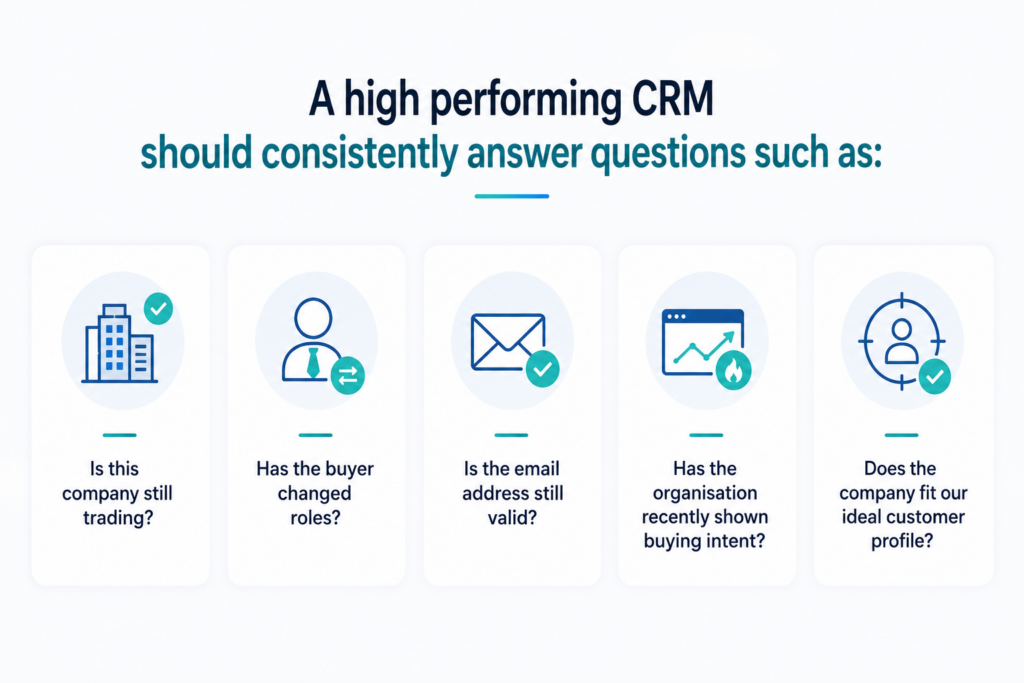
Without reliable answers, lead scoring becomes inaccurate and sales prioritisation suffers.
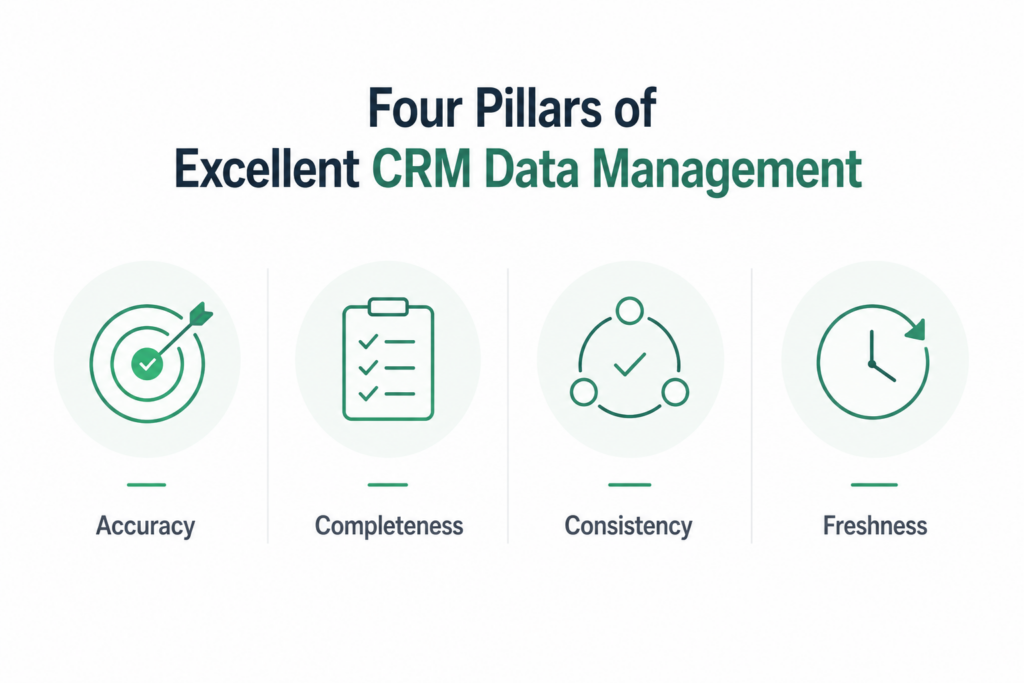
Four pillars of excellent CRM data management
- Accuracy
Customer information reflects current business reality.
- Completeness
Records include decision makers, industry, company size, contact details, buying stage, and relevant commercial insights.
- Consistency
Naming conventions, fields, and formatting remain standardised across every department.
- Freshness
Customer information is continuously updated as organisations, contacts, and buying behaviour change.
Together, these principles create a CRM that supports confident decision making rather than introducing uncertainty.
How Data Enrichment Strengthens Sales Intelligence
Data enrichment improves CRM data quality by adding valuable commercial information to existing customer records. Enriched data helps sales teams identify buying opportunities, personalise outreach, prioritise accounts, and accelerate pipeline movement with greater confidence.
A CRM should not function as a static database. Instead, it should evolve alongside your prospects.
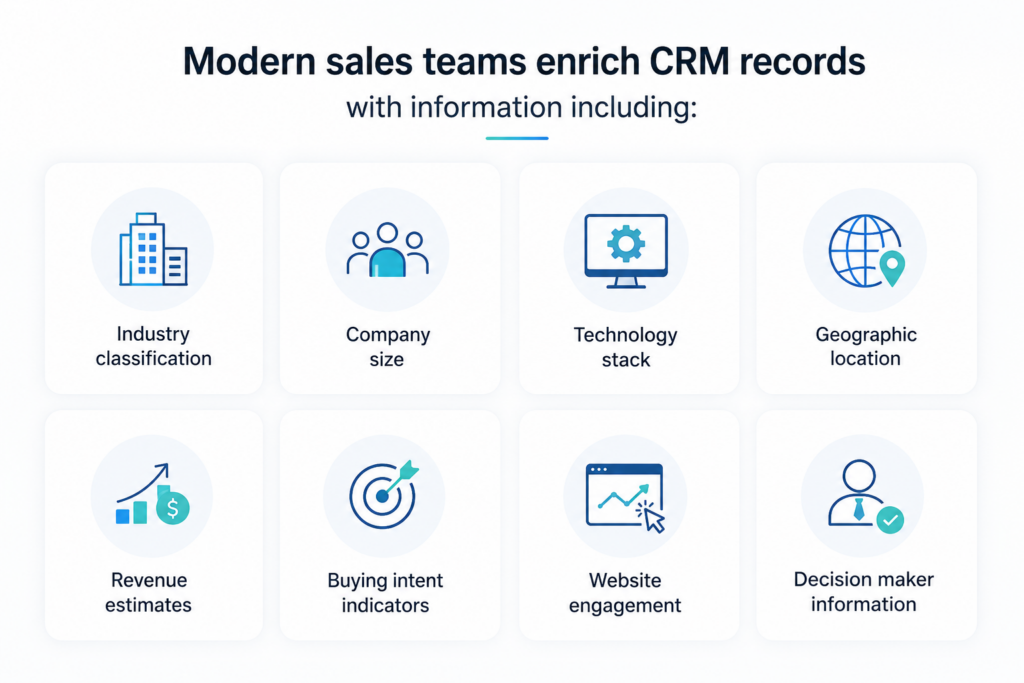
When enriched CRM records are combined with website visitor identification software, anonymous website traffic becomes significantly more valuable.
Rather than seeing anonymous visits in analytics, commercial teams can begin identifying businesses demonstrating genuine buying behaviour before competitors make contact.
This combination enables:
- Smarter lead scoring
- Better account prioritisation
- Faster outbound prospecting
- Higher quality sales conversations
- More effective account based marketing
Instead of guessing which prospects are ready to buy, businesses can focus resources on organisations already demonstrating commercial intent.
How RevOps Teams Maintain High CRM Data Quality
CRM data quality improves when Revenue Operations establishes consistent processes for data governance, validation, enrichment, and ongoing maintenance. Rather than relying on occasional clean ups, successful organisations treat data quality as a continuous business discipline that supports sales, marketing, and customer success.
Revenue Operations, often shortened to RevOps, connects sales, marketing, and customer success around a shared revenue strategy. A reliable CRM sits at the centre of that strategy.
Without clear ownership, customer data quickly becomes inconsistent. Different teams may create duplicate records, use conflicting naming conventions, or fail to update important account information after customer interactions.
A practical CRM data governance framework should include:
Establish clear data ownership
Assign responsibility for maintaining customer records, validating new entries, and resolving duplicate records.
Standardise data entry
Use mandatory fields, consistent naming conventions, and validation rules to reduce human error.
Audit CRM records regularly
Review records monthly to identify outdated contacts, inactive companies, incomplete profiles, and duplicate opportunities.
Automate where possible
Use CRM workflows to validate email addresses, standardise formatting, enrich records, and notify teams when critical information is missing.
Align teams around shared KPIs
Sales, marketing, and customer success should work from the same trusted data rather than maintaining separate versions of customer information.
Why Website Visitor Identification Makes CRM Data More Valuable
CRM data quality becomes significantly more valuable when enriched with website visitor identification and sales intelligence. Identifying businesses visiting your website gives sales teams additional buying context, helping them prioritise outreach, personalise conversations, and move qualified prospects through the pipeline more efficiently.
Many CRMs only capture information after a prospect completes a form or speaks with sales. That creates a visibility gap. Prospective buyers often research solutions across multiple visits before making contact. During this period, valuable buying signals remain hidden.
Website visitor identification helps bridge that gap by revealing organisations engaging with your website before they become traditional leads.
When integrated with a CRM, visitor intelligence can enrich existing records by providing:
- Companies actively researching your services
- Frequently viewed product or pricing pages
- Repeat website visits
- Buying intent signals
- Previously unknown target accounts
- Earlier engagement history
For sales teams, this means outreach is based on real behaviour rather than assumptions.
For marketing teams, campaigns become more relevant because audience segmentation reflects actual interest instead of static contact lists.
For leadership, pipeline reporting becomes more accurate because account activity is visible earlier in the buying journey.
When paired with a platform such as Dynamic Leads, businesses can combine website visitor identification with CRM enrichment and sales intelligence to build a more complete picture of each prospect. Rather than waiting for inbound enquiries, commercial teams gain the context needed to engage high value accounts sooner and with greater confidence.
Frequently Asked Questions
What is CRM data quality?
CRM data quality refers to the accuracy, completeness, consistency, validity, and freshness of customer information stored within a Customer Relationship Management system. High quality CRM data enables better sales decisions, more effective marketing campaigns, accurate forecasting, and improved customer experiences across every stage of the buyer journey.
Why is CRM data quality important for B2B businesses?
Poor CRM data leads to duplicate records, inaccurate reporting, inefficient sales activity, and missed revenue opportunities. High quality CRM data helps businesses prioritise qualified prospects, improve lead scoring, personalise customer engagement, and increase pipeline velocity while supporting better collaboration between sales, marketing, and customer success teams.
How can businesses improve CRM data quality?
Businesses can improve CRM data quality by implementing data governance policies, validating information at entry, removing duplicate records, enriching customer profiles, automating quality checks, and conducting regular audits. Integrating sales intelligence and website visitor identification also keeps customer records current and commercially valuable.
What is data enrichment in a CRM?
Data enrichment enhances existing CRM records by adding valuable information such as company size, industry, decision makers, technology stack, buying intent, and website engagement. Enriched records give sales teams better context for prioritising accounts and creating more personalised outreach strategies.
Unlocking the True Potential of Your CRM
CRM data quality is far more than a technical housekeeping task. It is a strategic growth driver that influences every stage of the customer journey, from lead generation and qualification to forecasting and long term retention. Businesses with clean, enriched, and consistently maintained CRM records make faster decisions, deliver more relevant customer experiences, and create stronger alignment between sales, marketing, and customer success.
As competition for qualified B2B buyers continues to increase, relying on incomplete or outdated customer data becomes an unnecessary risk. Organisations that combine robust CRM data management with website visitor identification and sales intelligence gain a clearer understanding of buyer behaviour and can act on opportunities before competitors do.
If you want to turn anonymous website traffic into qualified sales opportunities while improving the quality of your CRM, book a demo or start a trial with Dynamic Leads. Discover how visitor identification, sales intelligence, and CRM enrichment work together to help your team identify high intent prospects, prioritise outreach, and build a healthier, more predictable pipeline.