
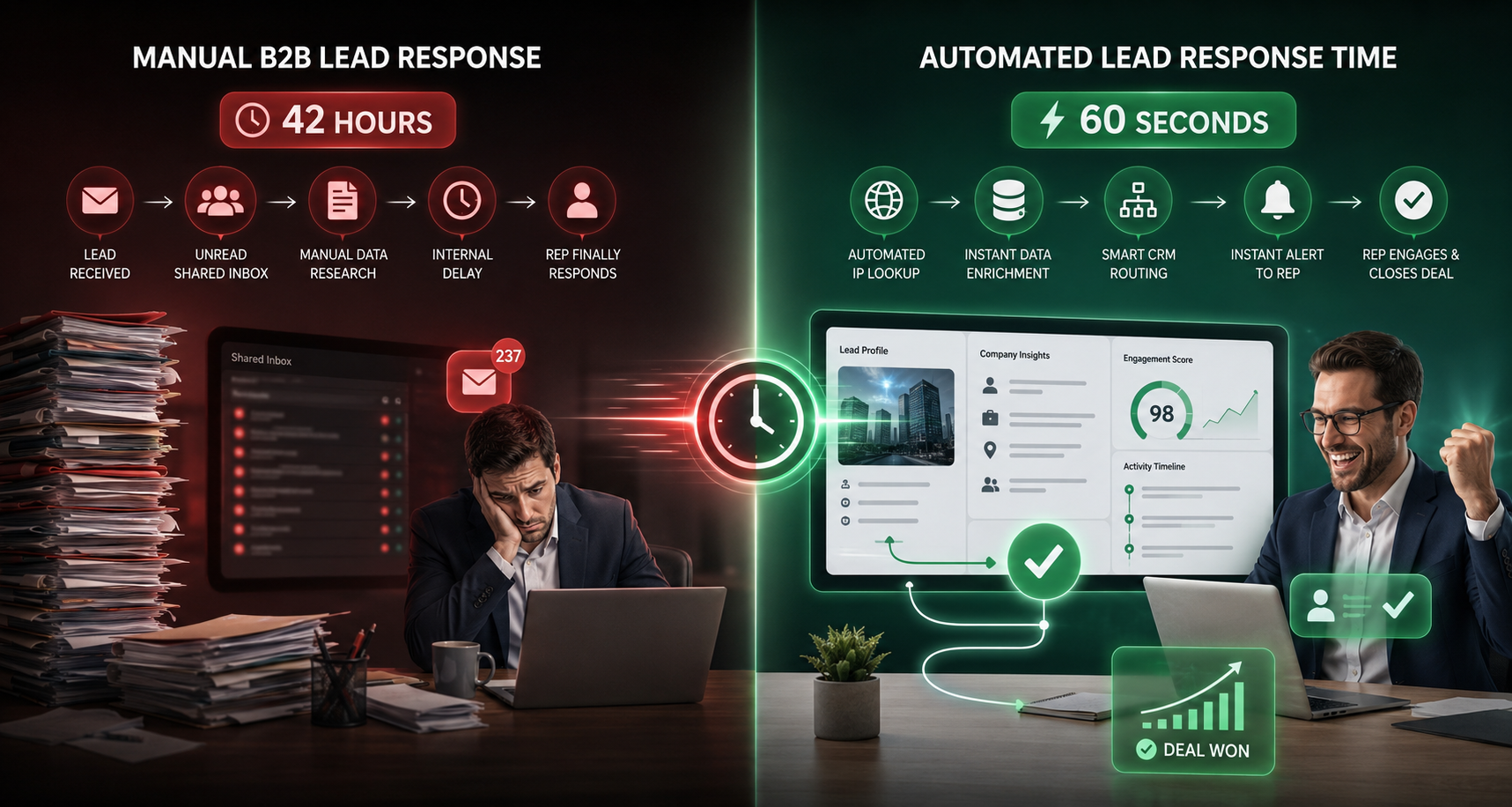
In B2B sales, speed is no longer just an operational advantage, it is the single deciding factor between closing a deal and losing a prospect to a faster competitor. Yet, the average B2B company takes an astonishing 42 hours to follow up with a new inbound inquiry. In a marketplace where 78% of buyers purchase from the vendor that responds first, this manual delay severely throttles pipeline growth.
Sales teams often struggle with slow response windows because traditional workflows rely on manual data entry, manual triage, and delayed rep assignments. This article outlines how modern sales automation transforms your lead response time, eliminating admin bottlenecks and ensuring high-intent prospects are contacted while their buying interest is at its absolute peak.
What Is Lead Response Time and Why Does Speed to Lead Matter?
Lead response time, often referred to as speed to lead, is the exact duration between a prospect expressing commercial intent (such as visiting a pricing page or filling out a form) and a sales representative making first contact. Achieving a fast lead response time captures buyers at peak intent, directly driving higher close rates.
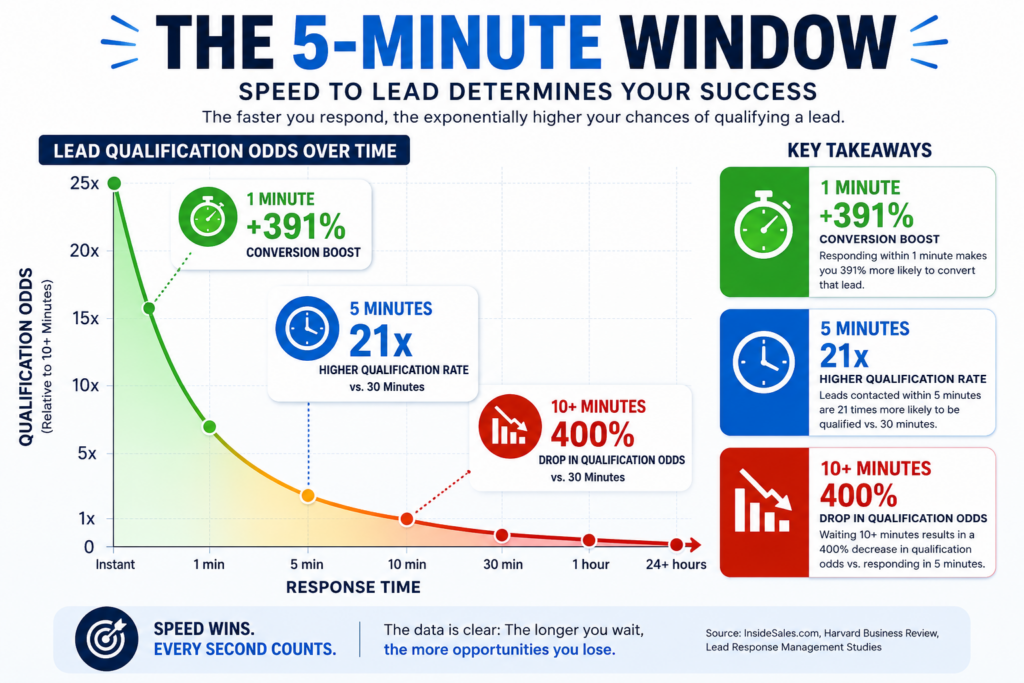
When a potential client engages with your website, their commercial interest is at its highest point. Delaying outreach degrades your lead response time, allowing their focus to shift elsewhere or opening the door for a competitor to capture their attention.
Crucial Lead Response Time Statistics in B2B Sales
Research from Harvard Business Review and MIT reveals that sales reps who optimize their lead response time to reach out within 5 minutes of an inquiry are 21 times more likely to qualify the lead compared to those who wait 30 minutes. Waiting just 10 minutes causes qualification rates to drop by 400%.
- Common Mistake: Treating all form fills equally and queueing them in a shared inbox for manual review at the end of the day.
- Strategic Fix: Deploying real-time automated notifications to instantly route high-intent leads to active reps.
Learn more about balancing technology with personal outreach in our guide to manual vs automated sales processes. For broader benchmarks on response decay, refer to the Harvard Business Review sales research on lead response times.
How Manual Triage Destroys Your Lead Response Time
Manual sales triage creates friction at every stage of the funnel, inflating your overall lead response time. When reps must manually lookup company details, check territory assignments, and draft initial emails, latency accumulates. Manual workflows push average lead response times past 40 hours.
Manual workflows fail to maintain a fast lead response time in fast-moving B2B environments due to four operational hurdles:
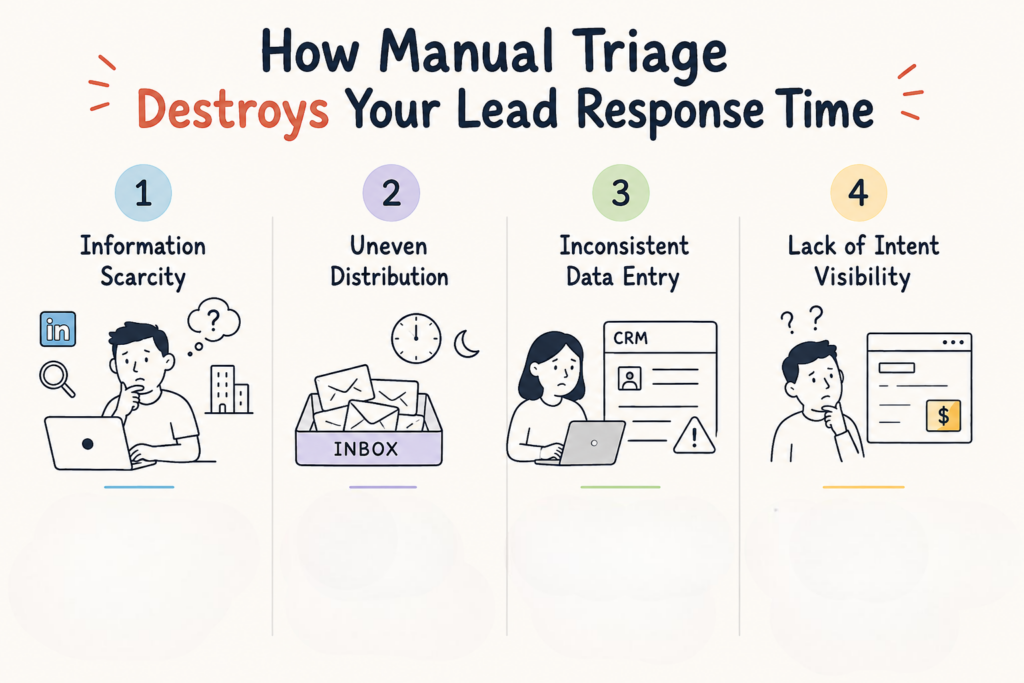
- Information Scarcity: Reps waste 15–20 minutes researching a company on LinkedIn before picking up the phone.
- Uneven Distribution: Leads sit unassigned in general inboxes during off-hours or busy sales periods.
- Inconsistent Data Entry: Manual CRM logging leads to duplicate records and missing contact details.
- Lack of Intent Visibility: Sales teams cannot distinguish between casual readers and high-intent buyers evaluating pricing pages.
- Manual lead handling inserts human latency at every step, causing high-value buyers to disengage.
How Sales Automation and Automated Lead Routing Optimise Lead Response Time
Sales automation removes human latency by executing lead discovery, data enrichment, scoring, and CRM assignment in real time to drastically improve lead response time. This enables sales reps to connect with prospects within seconds of peak intent. in real time. This enables sales reps to connect with prospects within seconds of peak intent.
1. Anonymous Website Visitor Identification
Up to 98% of B2B website traffic leaves without filling out a contact form. Software like Dynamic Leads uses IP lookup technology to deanonymize business visitors in real time. It reveals the company name, industry, duration, and exact pages visited, allowing sales teams to reach out before a form is even submitted.
2. Automated Instant Data Enrichment
Instead of requiring reps to manually search for contact information, automated workflows enrich records instantly. They pull decision-maker names, verified email addresses, and LinkedIn profiles directly into your CRM.
3. Intent-Based Lead Scoring & Routing
Not all leads require the same level of urgency. Automated systems analyze visitor behavior, such as viewing pricing pages or feature comparisons, and instantly route high intent leads to the correct account executive via Slack, Teams, or CRM alerts..
4. Automated Task Creation and Speed-to-Call Prompts
The moment a high-intent lead triggers a workflow, the CRM automatically generates a priority call task and dials or alerts the assigned rep, ensuring the first follow-up happens within the critical 5-minute window.
- Myth: Automation turns your sales outreach into cold, impersonal spam.
- Fact: Automation handles the background administration, providing reps with enriched data so their outreach can be more personalized and timely.
Implementing the Hybrid Model for Fast Lead Response
The most effective B2B sales strategy relies on a hybrid model: technology handles instant tracking, enrichment, and routing, while human reps execute consultative, relationship-driven outreach.
By connecting website visitor tracking directly into your CRM, your team gets instant context on what a prospect was researching right before the call. This transforms a standard cold outreach attempt into a highly relevant, warm sales conversation.
Explore how Dynamic Leads software automates B2B lead discovery to help your team hit <5-minute response times.
FAQs
What is a good lead response time for B2B companies?
A good lead response time in B2B is under 5 minutes. Research shows that reaching out within this window yields a 21x higher lead qualification rate compared to waiting 30 minutes.
How does sales automation improve lead response time?
Sales automation eliminates manual data entry, instant-matches company IP addresses, enriches contact details, and routes qualified prospects directly to sales reps in real time, cutting delays from hours to seconds.
What percentage of B2B buyers purchase from the first responder?
According to industry research, 78% of B2B buyers purchase from the vendor that responds to their inquiry first.
How can I track lead intent before a prospect fills out a form?
You can track lead intent using IP lookup software like Dynamic Leads, which identifies the company visiting your website and records their page history, session duration, and specific content interactions in real time.
Does automated lead response hurt personalisation?
No. Automation handles background administration, such as data enrichment and notification routing, giving sales reps the immediate context they need to deliver highly tailored, personal human outreach.
The Verdict: Accelerate Your Lead Response Time to Win More Deals
In modern B2B sales, optimizing your lead response time is one of the highest-leverage actions you can take to increase pipeline velocity and conversion rates. Relying on manual lead processing leaves high-value prospects waiting and gives competitors the opportunity to step in.
By pairing automated lead discovery and CRM routing with personalized human outreach, you ensure your sales team engages buyers at the exact moment their interest is highest.
Ready to turn your anonymous website traffic into qualified pipeline? Start your free 7-day trial of Dynamic Leads today and bring modern sales automation to your revenue engine.