
Successful outreach begins long before the first email is sent. Effective B2B prospect research allows sales and marketing teams to understand who they are contacting, what challenges they face and when they are most likely to engage.
Unfortunately, many organisations still rely on generic outreach campaigns that fail to resonate with decision makers. The result is lower response rates, wasted sales effort and missed revenue opportunities.
This guide explains a practical framework for researching prospects before outreach. You'll learn how to identify buying signals, uncover decision makers and leverage sales intelligence tools to create highly relevant conversations that generate more meetings and opportunities.
Why B2B Prospect Research Matters Before Outreach
Many outreach campaigns fail because the sender knows very little about the company or individual receiving the message.
Strong B2B prospect research helps teams move beyond generic prospecting and create outreach that feels relevant and timely.
Benefits include:
- Higher email reply rates
- Better lead qualification
- Improved sales efficiency
- More meaningful conversations
- Increased conversion opportunities
Before reaching out, gather information such as:
- Company size
- Industry and market position
- Recent business developments
- Technology stack
- Hiring activity
- Growth signals
- Current challenges
For example, a cybersecurity provider targeting SaaS companies can tailor messaging differently for a fast-growing startup than for an established enterprise business. The more context your team has, the easier it becomes to position solutions around genuine business needs rather than product features. Modern sales intelligence software and website visitor identification platforms make this process significantly faster by surfacing relevant company and contact insights automatically.
How to Conduct B2B Prospect Research Efficiently
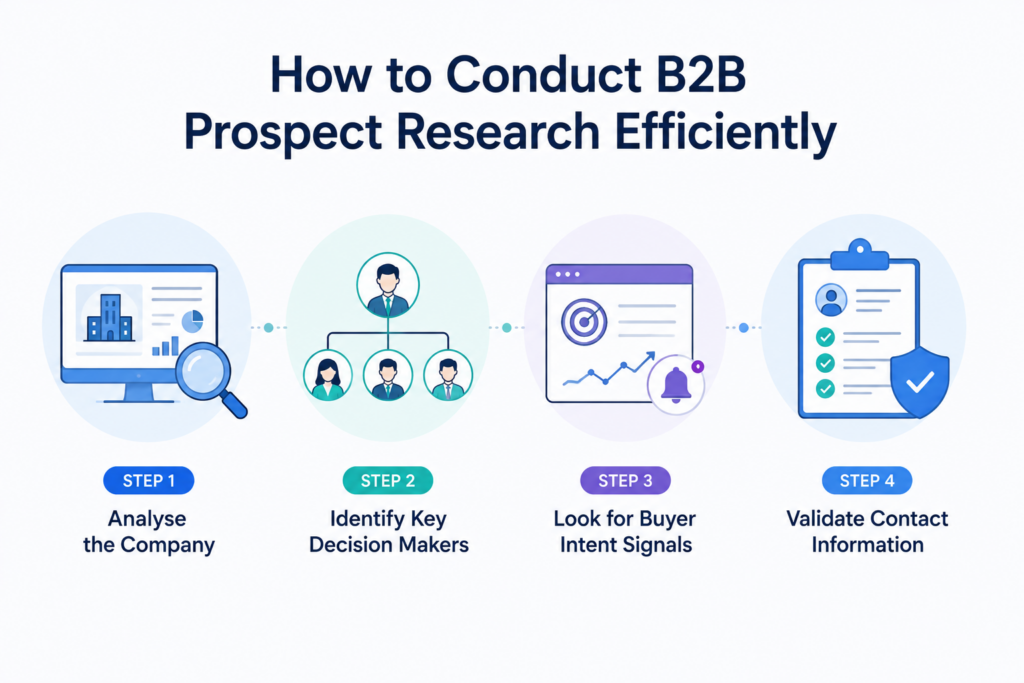
The most effective B2B prospect research process follows a structured approach rather than random information gathering.
Step 1: Analyse the Company
Start with the organisation itself.
Review:
- Company website
- About page
- Product offerings
- Customer case studies
- Press releases
- Careers page
These resources often reveal growth priorities, market positioning and business challenges.
Step 2: Identify Key Decision Makers
Once you understand the company, identify relevant stakeholders.
Research:
- Executive leadership
- Department heads
- Revenue leaders
- Marketing leaders
- IT decision makers
Focus on individuals most likely to influence purchasing decisions.
Step 3: Look for Buyer Intent Signals
Intent signals often indicate when a prospect may be evaluating solutions.
Examples include:
- New funding announcements
- Rapid hiring activity
- Product launches
- Technology changes
- Increased website engagement
Buyer intent data helps sales teams prioritise accounts with a higher likelihood of conversion.
Step 4: Validate Contact Information
Ensure contact information is current and accurate.
Accurate prospect data improves deliverability, protects sender reputation and reduces wasted outreach efforts.
How to Personalise Outreach Using Prospect Research Insights
Research only creates value when the insights are applied effectively. Once your team has gathered information about a prospect, the next step is transforming those insights into personalised outreach that captures attention and starts meaningful conversations.
Decision-makers receive dozens of sales emails and LinkedIn messages every week. Generic outreach often gets ignored because it focuses on the seller rather than the prospect's specific situation.
Effective personalisation demonstrates that you understand the prospect's business, challenges and priorities.
Reference Relevant Business Developments
Recent company activities can provide excellent conversation starters.
Examples include:
- New funding rounds
- Product launches
- Expansion into new markets
- Leadership appointments
- Partnerships and acquisitions
- Significant hiring initiatives
Instead of sending a generic sales pitch, acknowledge a recent business development and connect it to a potential challenge or opportunity your solution can help address.
For example, if a company is rapidly hiring sales representatives, a sales enablement provider might discuss how onboarding and productivity can become more challenging during periods of rapid growth.
Align Messaging with Industry Challenges
Different industries face unique pressures and priorities.
Research helps identify:
- Regulatory requirements
- Competitive pressures
- Technology trends
- Customer expectations
- Economic challenges
Tailoring outreach around industry-specific concerns makes messaging more relevant and increases the likelihood of engagement.
A manufacturing company focused on operational efficiency may respond to different messaging than a SaaS organisation focused on recurring revenue growth.
Speak to the Right Stakeholder
Personalisation should also reflect the priorities of the individual contact.
Different decision-makers often care about different outcomes:
- CEOs focus on growth and strategic objectives.
- Sales leaders focus on pipeline and revenue generation.
- Marketing leaders focus on lead quality and campaign performance.
- IT leaders focus on security, integration and operational efficiency.
- Finance leaders focus on costs, risk reduction and ROI.
Researching stakeholder responsibilities helps ensure outreach resonates with the person receiving the message.
Use Intent Data to Improve Timing
Even highly personalised messaging can fail if sent at the wrong time.
Buyer intent signals can help determine when prospects are actively researching solutions or experiencing business changes that create buying opportunities.
Examples include:
- Increased website engagement
- Technology implementation projects
- Funding announcements
- Hiring growth
- Competitor evaluation activity
By combining intent data with prospect research, sales teams can engage accounts when interest and urgency are highest.
Create Account-Specific Outreach Strategies
For high-value target accounts, consider building a customised outreach plan rather than relying on standard email sequences.
This may include:
- Personalised email campaigns
- LinkedIn engagement
- Account-specific content
- Executive outreach
- Multi-channel follow-up
Account-based personalisation often generates stronger engagement because it demonstrates a deeper understanding of the prospect's business environment and objectives.
When prospect research is combined with strategic personalisation, outreach becomes significantly more relevant, timely and effective. Instead of competing for attention with generic messages, your team can engage decision-makers with conversations that address real business priorities and opportunities.
Conclusion
Effective B2B prospect research is no longer optional for organisations competing in crowded markets. Understanding your prospects before outreach helps create personalised conversations, identify genuine buying opportunities and improve conversion rates.
The most successful teams combine structured research processes with modern sales intelligence tools to uncover valuable insights faster.
Ready to identify high intent prospects and improve outreach performance? Book a demo, start a free trial or contact Dynamic Leads today.
FAQs
What is B2B prospect research?
B2B prospect research is the process of gathering information about companies and decision makers before sales outreach to improve relevance and engagement.
Why is prospect research important?
It helps sales teams personalise messaging, identify business challenges and improve response and conversion rates.
What information should I research before outreach?
Focus on company size, industry, decision makers, growth signals, technology stack and buyer intent indicators.
How long should B2B prospect research take?
With modern sales intelligence tools, initial research can often be completed in a few minutes per account.
What tools help with B2B prospect research?
Sales intelligence software, website visitor identification tools, CRM systems and intent data platforms are among the most effective solutions.