

Revenue growth rarely depends on generating more leads alone. For most B2B software companies, sustainable growth comes from understanding how efficiently revenue is created across marketing, sales and customer success. That's where Revenue Operations Metrics become essential. Rather than viewing performance through isolated departmental reports, RevOps creates a unified framework that connects every stage of the customer journey.
By tracking the right metrics, SaaS leaders can uncover bottlenecks, improve forecasting accuracy and maximise revenue efficiency. In this guide, we'll explore the 10 most important metrics every B2B software company should monitor and explain why each one matters.
Why Revenue Operations Metrics Matter
Many organisations still operate with disconnected systems, fragmented reporting and conflicting departmental goals. Marketing celebrates lead volume, sales focuses on closed deals and customer success measures retention.
The result is limited visibility into overall revenue performance.
Revenue Operations solves this challenge by aligning teams around shared business outcomes.
Benefits of tracking Revenue Operations Metrics include:
- Improved sales and marketing alignment
- Better revenue forecasting
- Increased operational efficiency
- Faster pipeline movement
- More predictable growth
- Enhanced customer retention
When monitored consistently, these metrics provide a complete view of how revenue flows through the organisation.
The 10 Revenue Operations Metrics Every SaaS Company Should Track
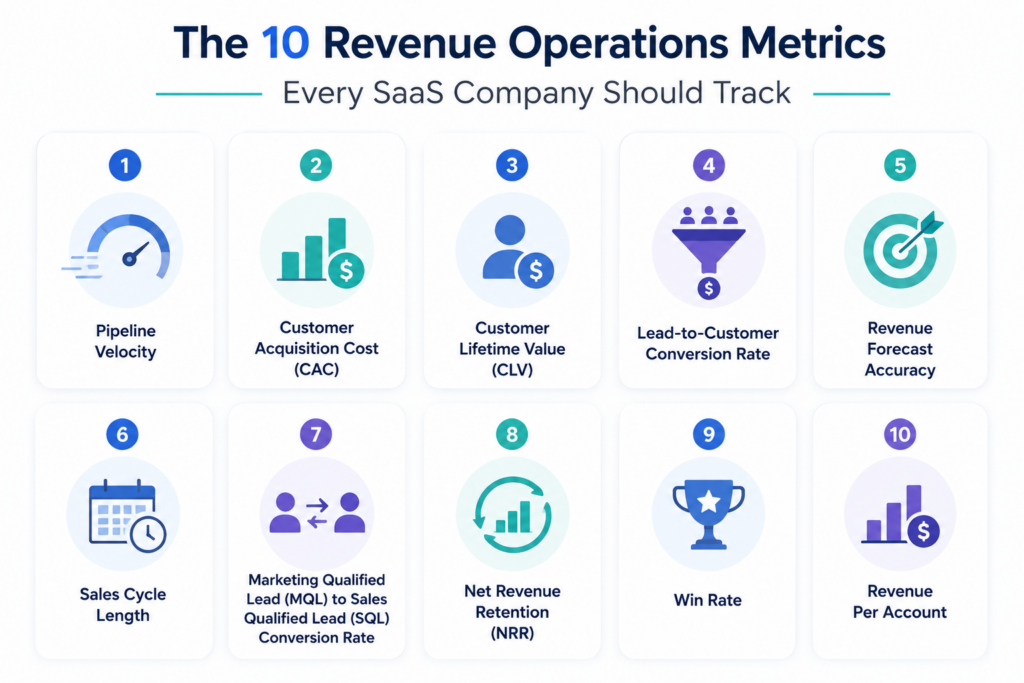
1. Pipeline Velocity
Pipeline velocity measures how quickly opportunities move through the sales funnel.
A strong pipeline velocity indicates efficient processes and healthy revenue generation.
Monitor:
- Opportunity volume
- Deal size trends
- Conversion efficiency
- Sales cycle duration
2. Customer Acquisition Cost (CAC)
CAC measures the total cost of acquiring a new customer.
This metric helps determine whether growth is financially sustainable.
Key considerations:
- Marketing spend
- Sales salaries
- Technology costs
- Agency fees
A rising CAC often signals inefficiencies in lead generation or conversion processes.
3. Customer Lifetime Value (CLV)
Customer Lifetime Value estimates the total revenue generated from a customer relationship. A higher CLV allows businesses to invest more aggressively in acquisition while maintaining profitability.
Factors affecting CLV:
- Retention rates
- Subscription length
- Upsell revenue
- Customer satisfaction
Successful RevOps teams continuously optimise both CAC and CLV together.
4. Lead-to-Customer Conversion Rate
This metric measures how effectively leads become paying customers.
A low conversion rate may indicate:
- Poor lead quality
- Weak qualification processes
- Sales enablement gaps
- Messaging misalignment
For businesses using website visitor identification tools and sales intelligence software, conversion rate improvements often come from better targeting and lead enrichment.
5. Revenue Forecast Accuracy
Forecasting accuracy compares projected revenue against actual results.
Reliable forecasts help leaders:
- Allocate resources effectively
- Manage hiring plans
- Support investor communications
- Improve budgeting
Poor forecasting often stems from incomplete CRM data and inconsistent pipeline management.
6. Sales Cycle Length
Sales cycle length tracks the average time required to close a deal.
Shorter sales cycles typically lead to:
- Faster revenue generation
- Lower acquisition costs
- Improved sales productivity
Revenue Operations teams analyse stage level bottlenecks to identify areas for optimisation.
7. Marketing Qualified Lead (MQL) to Sales Qualified Lead (SQL) Conversion Rate
This metric evaluates alignment between marketing and sales.
Strong MQL to SQL conversion rates suggest:
- Effective targeting
- Accurate lead scoring
- Shared qualification criteria
- Better cross team collaboration
8. Net Revenue Retention (NRR)
Net Revenue Retention measures revenue growth from existing customers after accounting for expansion, contraction and churn.
For SaaS companies, NRR is one of the strongest indicators of long-term health. World class SaaS businesses often achieve NRR above 110%.
9. Win Rate
Win rate measures the percentage of opportunities that become closed deals.
Tracking win rates helps identify:
- Competitive positioning strengths
- Sales process effectiveness
- Product market fit
- Pricing challenges
When combined with sales intelligence software, win rate analysis can uncover valuable buyer behaviour trends.
10. Revenue Per Account
Revenue Per Account measures the average revenue generated from each customer.
This metric highlights:
- Upselling success
- Cross selling effectiveness
- Customer expansion opportunities
- Account management performance
Growing Revenue Per Account can significantly increase profitability without increasing acquisition spend.
How Dynamic Leads Helps Improve Revenue Operations Metrics
Many businesses struggle to measure Revenue Operations Metrics because data is scattered across multiple platforms.
Dynamic Leads helps organisations:
- Identify anonymous website visitors
- Enrich lead records with firmographic data
- Improve lead qualification
- Accelerate pipeline velocity
- Enhance revenue forecasting accuracy
- Support sales and marketing alignment
By providing greater visibility into buying intent, businesses can make more informed revenue decisions and improve operational performance.
Supercharge Your Revenue Engine Today
Tracking the right Revenue Operations Metrics gives B2B software companies a clear understanding of what's driving growth and where revenue leaks occur.
Rather than relying on disconnected reports, a RevOps framework enables marketing, sales and customer success teams to work from a single source of truth.
If you're ready to improve pipeline visibility, accelerate revenue growth and optimise your Revenue Operations Metrics, contact Dynamic Leads today, book a demo or start your free trial to see how actionable revenue intelligence can transform your growth strategy.
FAQs
What are Revenue Operations Metrics?
Revenue Operations Metrics are measurable indicators that evaluate how effectively sales, marketing and customer success teams contribute to revenue growth and operational efficiency.
Why are Revenue Operations Metrics important for SaaS companies?
They provide visibility into pipeline performance, customer acquisition efficiency, forecasting accuracy and customer retention, enabling more predictable growth.
Which Revenue Operations Metric is most important?
The most important metric varies by business goals, but pipeline velocity, customer acquisition cost and net revenue retention are commonly prioritised.
How often should Revenue Operations Metrics be reviewed?
Most SaaS companies review key metrics monthly, while high growth organisations often monitor them weekly.
How can software improve Revenue Operations Metrics?
Revenue intelligence and sales intelligence platforms centralise data, improve reporting accuracy and help teams identify growth opportunities faster.