
If your B2B marketing strategy still leans on rented audiences, purchased lists, or third-party cookies, you're building on borrowed ground, and that ground is rapidly disappearing. The death of the third-party cookie isn't a future problem. It's here. And the marketers who saw it coming have already moved on to something far more powerful: first-party data.
This guide breaks down what first-party data actually is, why it's become the cornerstone of modern B2B marketing, and, most importantly, five proven strategies to collect, activate, and profit from it.
What Is First-Party Data (And Why Should B2B Marketers Care)?
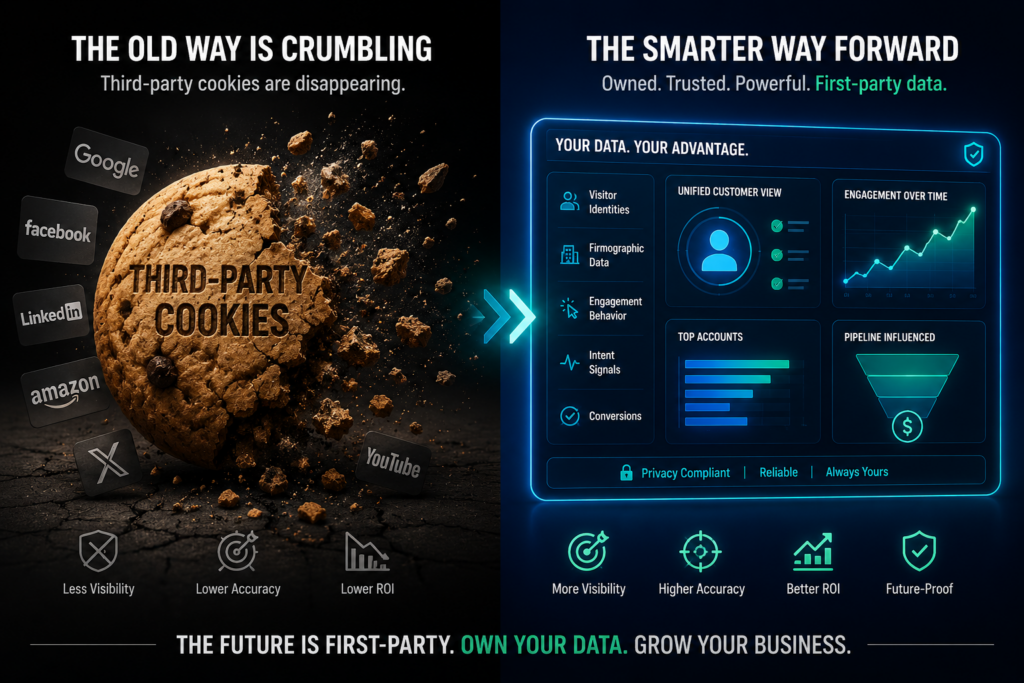
First-party data is information you collect directly from your own audience, including website visitors, CRM contacts, email subscribers and customers, with their knowledge and consent. Unlike third-party data (bought from external providers) or second-party data (shared between partners), first-party data belongs entirely to you. It's accurate, compliant, and, critically, it reflects genuine intent.
First-Party vs Third-Party Data: The Key Difference
| First-Party Data | Third-Party Data | |
| Source | Your own audience | External data brokers |
| Accuracy | High | Variable |
| Consent | Explicit | Often unclear |
| GDPR Compliance | Straightforward | Complex |
| Future-Proof? | ✅ Yes | ❌ No |
For B2B teams, the argument is clear: first-party data gives you a direct line to buyer intent, without the noise, the cost, or the compliance risk.
Why First-Party Data Strategies Are Now Essential
The Cookie Apocalypse Has Arrived
Google's deprecation of third-party cookies in Chrome, combined with Apple's App Tracking Transparency and increasingly strict GDPR enforcement, has fundamentally disrupted how B2B marketers identify and track prospects. Businesses that relied on external data pipelines are now flying blind. Ad retargeting is less precise. Audience segmentation is harder to trust. And the cost-per-lead on paid channels keeps climbing.
The response from the world's most effective B2B marketing teams? Go back to basics and own your data.
First-Party Data Is a Competitive Moat
When you build a robust customer data strategy around first-party signals, you create something your competitors simply cannot buy. You know who's visiting your website, what content they've consumed, how many times they've returned, and which pages suggest they're close to a buying decision.
That's not just data. That's pipeline intelligence.
5 Proven First-Party Data Strategies for B2B Marketers
1. Identify Your Anonymous Website Visitors
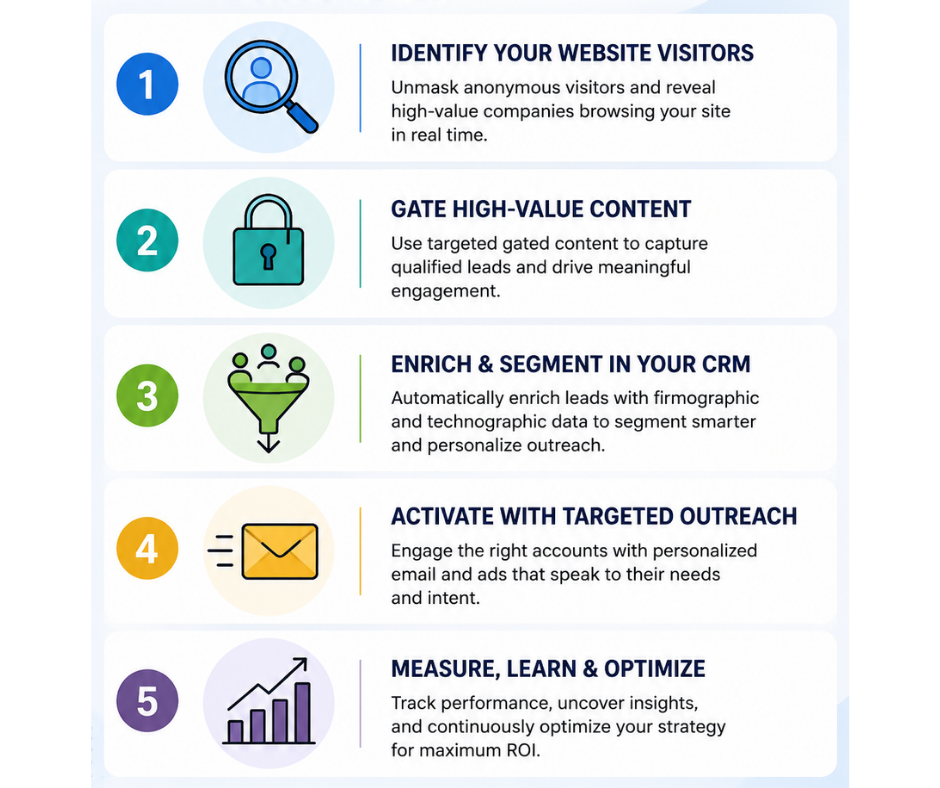
Your website is already generating high-intent first-party signals every day, but most businesses just aren't capturing them. Tools like Dynamic Leads allow you to identify the companies and individuals visiting your site, even before they fill in a form. Rather than watching anonymous traffic disappear into the void, you can turn those visits into actionable B2B leads.
This is arguably the fastest win available in any first-party data strategy: no new content required, no additional ad spend. Just visibility into demand that already exists.
2. Gate Your Best Content Strategically
Gated content, including whitepapers, benchmarking reports, toolkits and webinars, remains one of the most reliable first-party data collection tactics in B2B marketing. The key word is strategically. Don't gate everything. Gate the content that demonstrates clear expertise and justifies the exchange of contact details. A well-positioned gated asset doesn't just generate leads. It tells you exactly where a prospect is in their buying journey.
Best practices:
- Gate mid-to-bottom-of-funnel content (case studies, ROI calculators, comparison guides)
- Keep forms short: name, company email, and job title is enough to start
- Follow up within 24 hours using the data to personalise outreach
3. Enrich Your CRM With Progressive Profiling
Most B2B CRMs are riddled with incomplete records. A contact may have submitted a form two years ago with their name and email, and nothing else has been added since.
Progressive profiling solves this by gradually collecting more data across multiple touchpoints. Each new interaction, whether a webinar sign-up, a content download or a product page visit, is an opportunity to ask one additional qualifying question.
Over time, you build rich, accurate prospect profiles without overwhelming your leads with lengthy forms upfront.
4. Leverage Behavioural Intent Signals
First-party data isn't just what people tell you. It's what they do. Pages visited, time on site, content categories browsed, return visit frequency. These behavioural signals are powerful indicators of purchase intent. When integrated with your CRM and sales workflow, intent data allows your sales team to prioritise outreach based on genuine buying signals rather than gut instinct.
A prospect who has visited your pricing page three times in one week is not the same as someone who read a single blog post six months ago. Your outreach shouldn't treat them the same way.
5. Unify Data Across Channels for a Single Customer View
Siloed data is wasted data. Your first-party data strategy is only as strong as your ability to connect signals from email, website, CRM, social, and sales interactions into a single, coherent view of each prospect. This is where an omnichannel approach becomes critical. When all your data sources are connected, you can identify patterns that no single channel would reveal on its own, allowing you to personalise outreach at a level that genuinely moves the needle.
How to Activate Your First-Party Data
Collecting first-party data is only half the equation. The real value comes from activation, putting that data to work in your sales and marketing workflows.
Here's a straightforward activation framework:
- Segment: Group contacts by industry, intent level, and stage in the buying journey
- Personalise: Tailor email sequences, ad retargeting, and sales outreach based on behavioural signals
- Prioritise: Surface high-intent accounts to your sales team in real time
- Measure: Track which data signals correlate most strongly with conversion, and refine your approach
Measuring the ROI of Your First-Party Data Strategy
The beauty of first-party data is that it's measurable in ways third-party data never could be.
Key metrics to track:
- Data capture rate: What % of website visitors are you identifying?
- Lead-to-opportunity conversion: Are first-party leads converting at a higher rate than cold outreach?
- CRM enrichment score: What % of your CRM records are complete and actionable?
- Pipeline velocity: Are first-party leads moving through the funnel faster?
When these numbers improve, your first-party data strategy is working. When they stagnate, you know exactly where to focus.
The Bottom Line
The message is simple: the era of buying attention is over. The businesses winning in B2B right now are the ones who own their data, understand their audience, and use that understanding to show up at the right moment with the right message.
First-party data isn't a technical project; it's a strategic advantage. And with the right tools in place, it's one you can start building today.
Frequently Asked Questions
Any data you collect directly from your own audience qualifies: website visits, form submissions, CRM records, email engagement, event sign-ups, and chat interactions. The defining characteristic is that the data comes from direct interaction with your brand, with the individual's knowledge and consent.
First-party data is generally the most straightforward to manage under GDPR, provided you collect it transparently, store it securely, and use it only for purposes individuals have consented to. Always consult your data protection officer or legal team for guidance specific to your organisation.
Website visitor tracking is one component of a first-party data strategy. Tools like Dynamic Leads identify the companies and individuals visiting your site, even without a form submission — giving you a rich source of intent-based first-party data that most businesses leave uncaptured.
Ready to Turn Your Website Into a First-Party Data Engine?
Dynamic Leads helps B2B marketers identify, capture, and activate the high-intent visitor data already flowing through their website, without relying on third-party cookies or expensive data providers.
Stop guessing. Start knowing. Book Your Free Demo Today